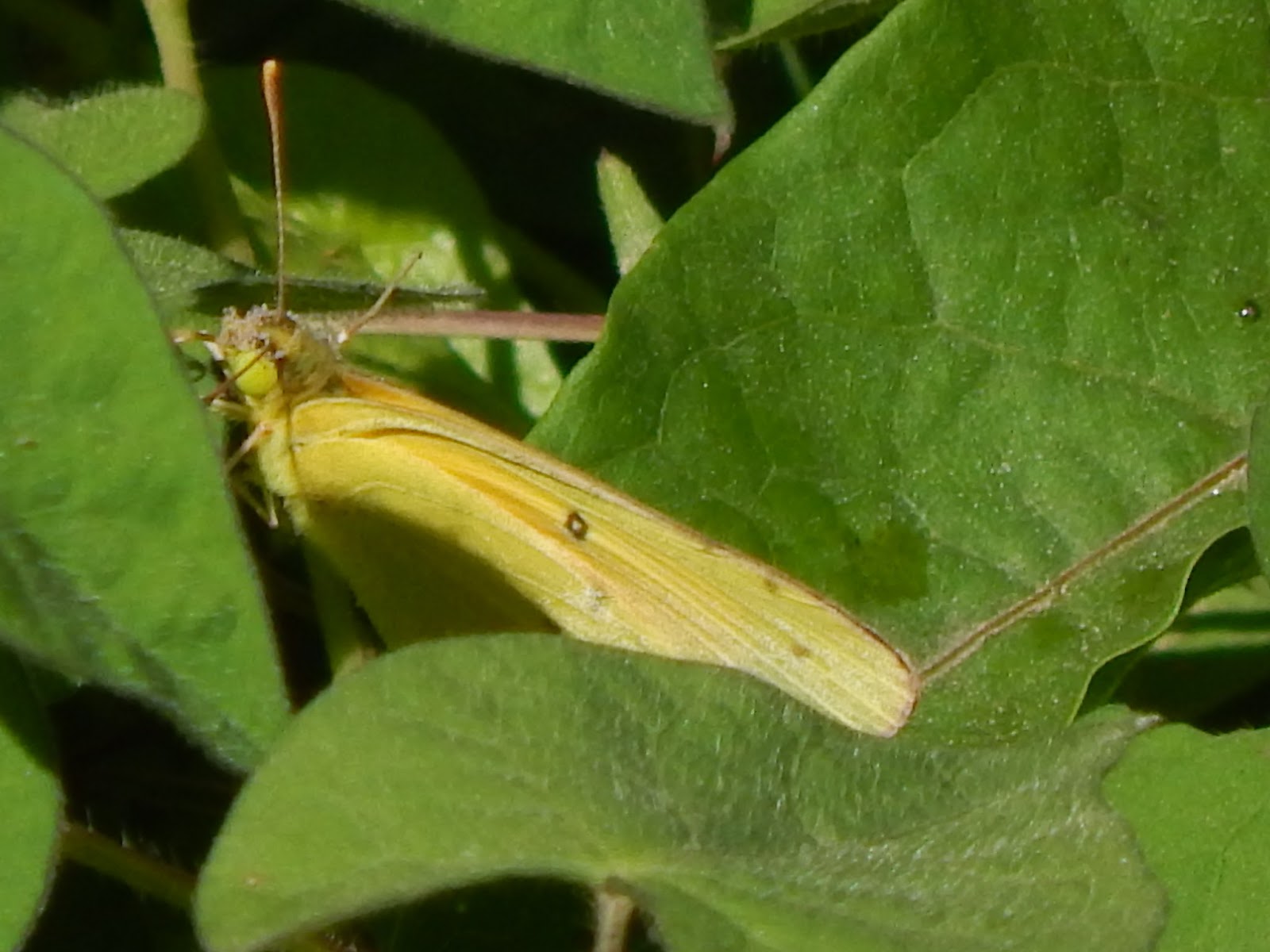
This blog entry comes right on the heels of another new entry. That one was a summary of Catahoula NWR and La Salle Parish observations from late May through June. Didn't leave my usual procrastinator's gap between these two blog posts.
**********************************************************************
Bayou Cocodrie NWR, Concordia Parish, 7/24/16:
 |
| male Dukes' Skipper (Euphyes dukesi) on host plant, near trail to observation platform on Bayou Cocodrie NWR | | |
|
|
|
I joined Craig Marks in searching for butterflies on Bayou Cocodrie NWR in Concordia Parish on July 24, and of course the outing also doubled as a birding trip for me. Despite the ominous thunder and gray skies that morning, the light drizzle eventually ceased and the butterflies came out in good numbers.
The area we were in is the east side of the refuge, in the vicinity of Poole Road and the side road that runs west from Poole Rd, past the observation platform, and down to the boat launch. Habitat there is bottomland hardwood forest (with lots of palmetto), weedy and brushy secondgrowth areas (WRP-type stuff), wide grassy road margins, the shore of a bayou, and a view of large wet-soil impoundments. Gravel roads and parking areas hold their appeal for butterflies as well.
The total list for the approx 5 hours (9:30-ish am to 2:30-ish pm) that we were in the field includes 27 butterfly species. Many were common, expected species, such as Horace's Duskywing, 'Astyanax' Red-spotted Purple, and Little Yellow.
 |
| a male 'Astyanax' Red-spotted Purple (Limenitis arthemis astyanax), Bayou Cocodrie NWR |
Carolina Satyrs were abundant along the trails through the woods where overall butterfly diversity was lower than in the open areas.
 |
| Dukes' Skipper (Euphyes dukesi) on host plant near the Bayou Cocodrie NWR headquarters |
 |
| Duke's Skipper, near Bayou Cocodrie NWR headquarters |
There were a few surprises, though. The definite highlight was locating two colonies of Dukes' Skipper -- one beside the Cypress Creek trail adjacent to the refuge headquarters grounds, and the other was beside the trail to the observation platform, approx one mile to the northwest of the first location. Both locations were patches of the skipper's host plant, which, if I understand correctly, is a sedge in the Carex genus, and were located in small clearings in wet woods. There were 8 Dukes' Skippers seen, total -- 4 patroling males at the location by the Hq; an ovipositing female and 3 more males in the vicinity of the observation platform trail.
These little butterflies are considered Threatened, with a NCGR ranking of 3, so it was exciting to locate two colonies. One wonders how many more are out there.
 |
| Dukes' Skipper (Euphyes dukesi) on host plant, near trail to observation platform on Bayou Cocodrie NWR |
Other new-to-me butterflies for the day included Least Skipper and Broad-winged Skipper, both adjacent to the boat launch on the north bank of Cross Bayou/Bayou Cocodrie.
 |
| Least Skipper (Ancyloxypha numitor), beside boat launch on Bayou Cocodrie NWR west of Poole Rd |
Craig braved the mud and sawgrass to get a good luck at the Broad-wings, who were in the reeds at the water's edge.
 |
| part of "puddle party" at the boat launch |
Other notable butterfly moments were the puddle party at the boat launch, which included 14 Red-spotted Purples, 11 Question Marks, 4 Hackberry Emperors, 2 American Snouts, 2 Horace's Duskywings, a Tropical Checkered-Skipper, and a Pearl Crescent
 |
| Some of the puddle party participants, including (left to right) Hackberry Emperor, Question Mark, and Red-spotted Purple |
 |
| The party continues down by the water with (left to right) Red-spotted Purple, Question Mark, and Horace's Duskywing (the two little ones at center-bottom) |
; and routinely having Hackberry Emperors landing on me, which I never get tired of. Hackberry Emps are attracted to sweat, so on a warm muggy day like this one was, we attracted our share of the bold little butterflies, providing up-close looks at our normally flighty quarry.
 |
| Hackberry Emperor on Craig |
 |
| Black-bordered Lemon Moth, Poole Rd near NWR Hq |
Butterflies were just part of the story, though. Starting with their fellow Lepidoptera, moths: there were many out and a nice variety of species, many that I did not recognize. At this point I haven't had a chance to i.d. all the ones that I've photoed, but some that I already knew included Black-bordered Lemon Moth (Marimatha nigrofimbra), Cross-lined Waved (Timandra amaturaria), Vetch Looper (Caenurgia chloropha), and Epipagis huronalis. I suspect that I saw some Lychnosea intermicata, but didn't get to get a good look at any. Photos of several moths are below.
 |
| tentative i.d.: Epipagis huronalis moth, Poole Rd near the Bayou Cocodrie NWR headquarters |
 |
| At first I thought I had seen a Smoky Tetanolita moth, but upon looking at photos I realized that this one was going to be more difficult to i.d. that I had expected!. I have much to learn. (Cypress Creek trail, Bayou Cocodrie NWR) |
 |
| moth (species TBD) on Palmetto, Cypress Creek trail, Bayou Cocodrie NWR |
 |
| tentative i.d.: Virginian Tiger Moth (Spilosoma virginica), forest trail west of Poole Rd, Bayou Cocodrie NWR [edited from "TBD" on 8/18 after a possible i.d. was determined] |
 |
| Great Egrets, Bayou Cocodrie NWR |
Birds were not especially conspicuous that day, but there was still a decent assortment to be seen and heard. Swainson's Warbler, Northern Parula, and Common Yellowthroat were the only warblers located, though. Indigo and Painted Buntings and Blue Grosbeak were present. There were a good many Great Egrets, plegadis Ibis sp., and other waders viewed at a distance from the observation platform. Two Mississippi Kites were circling and calling to one another over a forest trail. A Loggerhead Shrike was a nice find just before leaving the refuge.
 |
| Black Vulture, Bayou Cocodrie NWR |
|
The best bird experience, though, was 'hanging out' with a wild Black Vulture at the observation platform. When I noticed the bird perched on the boardwalk railing as I approached the platform, I stopped to take some photos. The bird was unusually tame and actually made its way down toward me, coming to within yards of me. I suspect it has been given handouts of food in the past (which is against the rules). Whatever the reason for the bird's friendly disposition, it was a treat to get to observe it so close for several minutes -- snapping lots of photos and taking several short videos -- without the bird being stressed or frightened.
 |
| Black Vulture, Bayou Cocodrie NWR observation platform |
On the herp front: we didn't see any snakes, which was somewhat surprising. Several frog species were heard, including numerous Squirrel Treefrogs near the observation platform and Cope's Gray Treefrog, Green Treefrog, and Blanchard's Cricket Frog vocalizing at various locations. Green Frogs and/or Southern Leopard Frogs were glimpsed leaping out of our path throughout the day. Squirrel Treefrogs can be heard in this video.
A family of Northern Raccoons, and a rabbit leaping into cover along the road, were the day's mammals
 |
| mamma raccoon and two of her four little ones |
 |
| tentative i.d.: Waterpod (Hydrolea quadrivalvis),Bayou Cocodrie NWR |
Wildflowers were limited, but far from lacking. Finding Hydrolea in bloom at multiple locations was very nice. I believe these may be H. quadrivalvis, a different species that the two Blue Waterleaf species (H. ovata and H. uniflora) that I see on Catahoula NWR. Verbenas, Frogfruit (Phyla), Carolina Nightshade (Solanum), Helenium, Virginia Buttonweed (Diodia virginiana), Trumpet Creeper (Campsis radicans), and Persicaria were some of the plants that were in bloom.
 |
| tentative i.d.: Waterpod (Hydrolea quadrivalvis). near observation platform walkway |
Complete butterfly list is below. Thanks to Craig for putting the list together. Photos for several species are shown as well. For some species that were especially numerous, exact numbers aren't given, but rather 'A' for abundant and 'VA' for very abundant are used.
 |
| Little Yellow, Bayou Cocodrie NWR |
Pipevine Swallowtail - 1
Eastern Tiger Swallowtail - 3
Cloudless Sulphur - 7
Little Yellow - 10
Sleepy Orange - 1
 |
| Sleepy Orange nectaring on Brazilian Verbena, observation platform parking area, Bayou Cocodrie NWR |
Red-banded Hairstreak - 4
Gray Hairstreak -2
 |
| Gray Hairstreak beside Poole Rd |
 |
| Gray Hairstreak at boat launch parking area |
 |
| Pearl Crescent, trail through woods west of Poole Rd |
American Snout - 6
Gulf Fritillary - 1
Phaon Crescent - 17
Pearl Crescent - A
Common Buckeye - 2
Question Mark - 15
Viceroy - 11
'Astyanax' Red-spotted Purple - 25
Hackberry Emperor - VA
Carolina Satyr - A
 |
| Viceroy, observation platform parking area |
 |
| Hackberry Emperor, trail parking west side of Poole Rd |
 |
| Carolina Satyr, trail through woods west of Poole Rd |
Silver-spotted Skipper - 1
Horace's Duskywing - A
 |
| Horace's Duskywing at observation platform parking area |
Tropical Checkered-Skipper - 9
 |
| Tropical Checkered-Skipper at boat launch |
 |
| Least Skipper on the shore of Cross Bayou |
Least Skipper - 2
Southern Skipperling - 1
Clouded Skipper - 7
Fiery Skipper - 1
Dukes' Skipper - 8
Broad-winged Skipper - 2
Dun Skipper - 3
 |
| Dukes' Skipper beside observation platform trail |
 |
| Dukes' Skipper, near observation platform trail |
 |
| Clouded Skipper beside Pool Rd |
 |
| "Bye." |