Monday, April 25, 2016

Kisatchie National Forest / Catahoula Hummingbird and Butterfly Garden, Grant Parish, 4/22/2016

Eastern Bluebird, Catahoula Hummingbird and Butterfly Garden, Grant Parish, Louisiana
   One of the most enjoyable things about getting out in nature is sharing the experience with someone. This time I was joined by my very dear long-time friend Keisha Johnson. This was her first time birding, but being the intelligent and inquisitive person she is, she'd been curious about it for some time.

Baltimore Oriole, Catahoula Hummingbird and
Butterfly Garden, Grant Parish
   Before visiting the Catahoula Hummingbird and Butterfly Garden and Work Center Road area of Kisatchie National Forest, in the Catahoula Ranger District in Grant Parish, we made a quick visit to Sparrow Street near Jena in La Salle Parish. The Swainson's Warbler observed there by myself and Tom Pollock on 4/15 was singing again this morning, as was another one near the south end of the road. Lots of other songbirds, including Yellow-breasted Chat, Prairie Warbler, Red-eyed Vireo, and Indigo Bunting, were also singing. Oddly, we didn't get Hooded Warbler -- one of our region's most common summer woodland birds -- on this trip.
   When we arrived at the butterfly garden, there was a group of both Baltimore Oriole and Orchard Oriole present, along with several Gray Catbirds. Red-headed Woodpecker was calling nearby, but no sign of the resident Red-cockaded Woodpeckers who have a colony adjacent to the garden.
tentative i.d.: Northern Cloudywing (Thorybes pylades), Catahoula Hummingbird and Butterfly Garden, Grant Parish
Broad-headed Skink at Butterfly Garden

   There were limited flowers in bloom at the garden at this time (it's still a bit early) and the only butterfly we got there was a presumed Northern Cloudywing (tricky, confirmation of i.d. pending.). We did see an impressive Broad-headed Skink and colorful Common Five-lined Skink as well as a Green Anole. Green Treefrog and Cope's Gray Treefrog were heard.
Common Five-lined Skink at Butterfly Garden
   We walked the old road or trail that surrounds the northern part of the block of woods southwest of the garden. Here's a good example of the type of pine forest found in the Kisatchie NF. Among the bird species singing and presumably on breeding territories in the woods were Bachman's Sparrow and Pine Warbler. Brown-headed Nuthatches were especially common. Chipping Sparrows and Mourning Doves were also regularly seen and heard.
Northern Mockingbird, Kisatchie National Forest, Grant Parish
Mourning Dove, Kisatchie NF, Grant Parish
   The woods are surrounded by a wide band of open, meadow-type habitat where species that prefer weedy and brushy habitats are found. Prairie Warblers were common, as were Yellow-breasted Chat and Blue Grosbeak.
   Along the path are a number of bluebird nest boxes, many apparently occupied.
   Three Anhingas were seen gliding west, high overhead. Presumably they were passing from appropriate wetland/swamp habitat near Little River or Catahoula Lake to appropriate habitat around Iatt Lake or Red River. Or, who knows where?
   Raptors present included a pair of Red-tailed Hawks, three Broad-winged Hawks soaring quite high, and, alongside the BWHA, a Mississippi Kite. Keisha was the first to notice all of these species.
tentative i.d.: Swarthy Skipper (Nastra lherminier), Kisatchie National Forest west of Work Center Rd.
I'm not 100% on this i.d.
   We encountered a few Lepidoptera species on this approximately two-mile walk. Several (tentative i.d.) Swarthy Skippers were seen. I encountered this species here last year and it appears they may be quite common here. We had good looks at three larger butterflies: the American Lady, ...

American Lady (Vanessa virginiensis) nectaring on Coreopsis, west of Work Center Road
 ...the Question Mark, ...
Question Mark (Polygonia interrogationis) feeding on scat
 ...and the Common Buckeye.
Common Buckeye (Junonia coenia), Kisatchie NF
A couple of times, we also had poor looks at yellow sulphur-type butterflies as well. Several small moths were seen, but the only easily i.d.-ed one was The Wedgling.
The Wedgling (Galgula partita), Kisatchie NF west of Work Center Road
tentative i.d.: Curtiss' Milkwort, Kisatchie NF west of Work Center Rd.
I find this i.d. questionable, but it's the closest match I've found so far.
 
   Wildflowers were fairly impressive. Coreopsis (possibly Lobed Tickseed -- Coreopsis auriculata?), Phlox (possibly Hairy Phlox -- P. amoene?) and Spiderwort (Tradescantia) were among the most frequently encountered.
Coreopsis sp., west of Work Center Rd.
Phlox species, west of Work Center Road

Spiderwort species, west of Work Center Road, Kisatchie NF, Grant Parish
tentative i.d.: Helmet Flower
Helmet Flower (tentative i.d. Scutellaria integrifolia), with their purple-blue, white-marked flowers were noticed a few times.
There were a good many Venus's Looking-Glass (Triodanis perfoliata) plants seen without blooms, but a few with the lovely purple flowers were eventually found. Both Yellow Woodsorrel (Oxalis stricta, tentative i.d.) and Violet Woodsorrel (Oxalis violacea, tentative i.d.) were found to be pretty common, as was Blue-eyed Grass (Sisyrinchium).
tentative i.d.: Violet Woodsorrel, Kisatchie NF
A Lobelia (possibly Lobelia appendiculata -- Pale Lobelia??) was spotted.
Lobelia species, Kisatchie NF near the butterfly garden
Tentatively i.d.-ed Curtiss' Milkwort (Polygala curtissii), Cutleaf Geranium (Geranium dissectum), and Sicklepod Coffeeweed (Senna obtusifolia) were also encountered. Introduced species that have joined the native flora included Japanese Honeysuckle (Lonicera japonica), Crimson Clover (Trifolium incarnatum), and tentatively-identified Ligustrum privet species.
tentative i.d.: Cutleaf Geranium in foreground, w/ Yellow Woodsorrell in background
   It should be noted that I'm a novice at wildflower identification, so there could certainly be some misidentified plants on the list (http://southeasternflora.com/ and http://www.wildflower.org/plants/ are good online resources to check i.d.'s for yourself, should you be interested.).
   This was an excellent Earth Day spent in the field. By the end of our birding, Keisha (Miss never-been-birding) was independently identifying some birds and exhibiting skills at picking out birds, animal tracks, and other things of interest that many people more acquainted with the outdoors would usually overlook. My advice to any birders (or herpers, or butterflyers, etc.) reading this is to take a non-birder(etc.) friend in the field with you sometime. They might just be a natural, and you might just get them hooked on the outdoors!
   Complete bird list for the B-fly Garden and Kisatchie NF location is below.
Brown-headed Cowbird, near butterfly garden
........................................................................................
8:42 am to 12:33 pm
67 to 81 degrees f., sunny, light breeze
walked approx. 2 miles

Anhinga - 3

Turkey Vulture - 2
Mississippi Kite - 1
Broad-winged Hawk - 3
Red-tailed Hawk - 2

Mourning Dove - 5

Chimney Swift - 2

Ruby-throated Hummingbird - 2

Red-headed Woodpecker - 1
Red-bellied Woodpecker - 1
Downy Woodpecker - 1
Northern Flicker - 1

Eastern Wood-Pewee - 3
Eastern Kingbird - 2

Red-eyed Vireo - 1

Blue Jay - 3

Purple Martin - 8
Barn Swallow - 1

Carolina Chickadee - 3
Tufted Titmouse - 1

Brown-headed Nuthatch - 9

Carolina Wren - 4

Blue-gray Gnatcatcher - 2

Eastern Bluebird - 5

Gray Catbird - 5
Brown Thrasher - 1
Northern Mockingbird - 3

Cedar Waxwing - 10

Common Yellowthroat - 2
Pine Warbler - 2 (probably more)
Prairie Warbler - 5
Yellow-breasted Chat - 6

Bachman's Sparrow - 1 (probably more)
Chipping Sparrow - 7
Savannah Sparrow - 2

Summer Tanager - 1
Northern Cardinal - 2
Blue Grosbeak - 5
Indigo Bunting - 2

Brown-headed Cowbird - 2
Orchard Oriole - 9
Baltimore Oriole - 4

American Goldfinch - 2
..............................................................................................................

Saturday, April 16, 2016

Spring migration is well underway; warblers, tanagers, buntings, and more in La Salle Parish

Swainson's Warbler singing beside Sparrow Street, west of Jena, La Salle Parish
   I joined Tom Pollock for some birding in wooded rural La Salle Parish on April 15. We planned to visit Snyder Road - a favorite spot of both of ours for Swainson's Warbler and other neotropical songbirds that arrive on their local breeding grounds around this time of year. However, while casually birding as we drove Sparrow Street on the way out there we heard a Swainson's singing right beside the road and stopped to have a listen and hopefully see this typical shy little woodland bird. We weren't disappointed.
   The Swainson's Warbler, singing frequently just south of the little Trout Creek bridge, was seen several times and eventually posed for a few minutes on a perch at the edge of the road clearing (junction of Sparrow Street and Ernestine Road). This, we both agreed, was the best view we'd ever gotten of a typically shy SWWA, and the photos and videos that resulted were, while not great quality, quite good for a species which normally seems reluctant to leave the thick underbrush of it's preferred habitat.
Swainson's Warbler, Sparrow Street, La Salle Parish
   We did use audio playback a bit at first to try to get the bird to come to us, but not excessively, and the most rewarding period was when we stopped the playback and just let the bird do its thing.
   I could go on about the Swainson's Warbler (it's a personal favorite species of mine), but the stop was fortuitous also for being a great spot to get several other neotropical species. Especially some of the SWWA's fellow wood warblers. A male Hooded Warbler - one of several who were singing within earshot of this spot - also put in an appearance, and we heard Black-and-white Warbler, Worm-eating Warbler (FOS), Common Yellowthroat, Prairie Warbler, Yellow-breasted Chat, as well as the resident Pine Warblers. All were singing, some of them - yellowthroat, Prairie, and Pine - were also seen.
male Hooded Warbler, Sparrow Street west of Jena, La Salle Parish
male Prairie Warbler, Sparrow Street, La Salle Parish
   Other recently-arrived neotrops besides warblers that were heard or seen here were Red-eyed Vireo, Wood Thrush, Indigo Bunting, Great Crested Flycatcher (FOS), and Eastern Kingbird (flyover headed north). Eventually, the sporadic sprinkles coalesced into a steady drizzle and we called it quits for the morning after less than an hour at the SWWA spot. We had a fruitful morning without even reaching our intended destination.
   Other FOS seen in the Jena area that morning included a male Summer Tanager and a possible (brief glimpse in poor light) Blue-winged Warbler.
......................................................................................
male Indigo Buntings, photo from last year's
spring migration (4/23/15)
   Recently, I've been hearing lots of Indigo Buntings passing overhead during nocturnal outings. These are among the most recognizable and abundant neotropical migrants around and rainy days during mid-April often bring them into yards where they frequent bird feeders while getting a respite from the weather. They seem to be everywhere I look this week! I am certainly not complaining.
This is a great time of year to look for migrants of various sorts and a great variety of birds - some who will be breeding in our area, some who are only stopping by on their way further north - will be showing up in a park or forest or backyard near you. Keep your eyes and ears open; there's no telling what you might find!
Palm Warbler, 4/11/2016, Jena, La Salle Parish.
 

Friday, April 8, 2016

Chalk Hills afternoon, other Catahoula and La Salle Parish observations

Phlox blooming in the Chalk Hills

   On April 3rd I joined Beth Willis and Tom Pollock for some birding. The final goal was to search for Whip-poor-wills and Chuck-wills-widows at nightfall along Posey-Webb Camp Highway in and around the Chalk Hills, but first we did a little birding elsewhere in La Salle and Catahoula Parishes. We heard a Black-and-White Warbler (first of season for me) and saw a soaring Bald Eagle near the Whitehall community in La Salle. We checked out the flood waters along Hwy 126 between Manifest and Sandy Lake, including where it cuts across the Bushley Bayou Unit of Catahoula NWR. Though water levels are dropping, the water is still high and there's a couple-of-mile stretch where the water is up by the road. Here we saw a few Blue-winged Teal as they swam from the roadside and off into the woods.
water over the road at one of the entrances to Catahoula NWR Bushley Bayou Unit along Hwy 126,
a typical scene along this stretch of highway at this time
   Lots of Phlox (which species, I can't say) were in bloom along Hwy 126 where it climbs into the Chalk Hills between Manifest and Aimwell. These bright purple flowers were also seen along P-WC Hwy. A few of the other wildflowers seen during this outing, in various locations, include Common Vetch, False Garlic, and Viola species (maybe Sweet White Violet? Bog White Violet?).
tentative i.d.: Common Vetch

Louisiana Waterthrush habitat
along Posey-Webb Camp Hwy
   Driving Posey-Webb Camp Hwy (just a narrow blacktop road) west-to-east, we found only the expected species until we stopped at the little creek east of the junction with Posey-Webb Camp Road (a tributary or branch of Hawthorn Creek, I believe). Here we heard at least one Wood Thrush, which was a first-of-season for us and saw and heard three Louisiana Waterthrushes, which were also FOS. The LAWA were very vocal; two singing and all calling as they made their way up the creek and crossed back-and-forth over the road several times. The birds were vocalizing on their own at first, then responded to playback that we used briefly to get them into view. However, when the audio was ended they continued to chase each other back and forth and vocalize enthusiastically. My guess is we were witnessing a territorial male, with his mate nearby, drive off another male.(?) Vocalizing can be heard in the video.
   Other birds heard and seen at that stop included Hairy Woodpecker, Pileated Woodpecker, an assortment of the expected woodland birds, and some flyover Great Egrets.
   Back at the cutover at the junction of the road mentioned above we spotted a Great Horned Owl scanning the grass and brush for prey from it perch at dusk. This was our first stop to listen for Chuck-wills-widow and Whip-poor-will. The method we used was to listen, then use playback to try to illicit a response, then listen again before moving to the next promising spot, listening w/ the windows down as we went. We worked our way back to the west end of the road at Aimwell, but didn't get any definitive Chuck or Whip vocals. However, we thought that we may have heard one or the other very distant and calling only a few times when we were at the owl location.
>>>>>>>>>>>>>>>>>>>>>>>>>>>>>>>>

   On April 6 I joined Tom for a trip out to Catahoula NWR Headquarters Unit. As we suspected, the unit was closed from high water (word from refuge staff is that it will likely be a month before water levels are low enough and roads dry enough to open the refuge).  So, we made a visit to the nearby Little River Recreation Area (Catahoula Parish). Here I had my FOS Prothonotary Warbler.
Prothonotary Warbler at Little River Recreation Area
We stopped near the Hwy 84 bridge over Old River (La Salle Parish) to watch the Cliff Swallows that have a nesting colony there. We couldn't locate a single Barn Swallow in the mix. During the last few years the Cliffs seem to have incrementally replaced the Barns, which used to be the dominant swallow species nesting at the bridge. Video is of Cliff Swallows at the bridge.
   We made token attempts at the Stephenson Rd and Bursley Bayou Rd entrances to the Bushley Bayou Unit of the refuge (yeah, there doesn't seem to be a consensus on the spelling/pronunciation of the name of the bayou... lol. I usually heard "Burshley".) in Catahoula Parish. Both were closed because of the flood, but the wildflowers along these roads were nice to see, including lots of Spider Lilies along BB Rd and some Swamp Leatherflower along Stephenson Rd and loads of Ranunculus (buttercups) everywhere.
Swamp Leatherflower, entrance to Catahoula NWR Bushley Bayou Unit on Stephenson Road
>>>>>>>>>>>>>>>>>>>>>>>>>>>>>>>>>

   Tom also reports that on a short visit to Snyder Road west of Jena in La Salle Parish, also on 4/6, that he heard Red-eyed Vireo, but no Hooded Warbler or other of the several neotropical warbler species that will be present here for the breeding season (this is one of the best places to find Swainson's Warblers in this area, April-July).
>>>>>>>>>>>>>>>>>>>>>>>>>>>>>>>

   Some neotropical migrants that I have found to have arrived already in La Salle and Catahoula Parishes include Green Heron, Mississippi Kite (one seen briefly in flight, earlier than I usually see them), Chimney Swift, Ruby-throated Hummingbird, Eastern Kingbird, White-eyed Vireo (though they are occasionally found wintering here), Purple Martin, Barn Swallow, Cliff Swallow, Blue-gray Gnatcatcher (though they are moderately common wintering birds in some places in the southern part of the parish), Wood Thrush, Gray Catbird (though a small number winter in the area), Black-and-White Warbler, Louisiana Waterthrush, Northern Parula, Prothonotary Warbler, Hooded Warbler, Orchard Oriole (one male seen, earlier than expected). Likely, many more species have also arrived.

   Butterflies I've seen so far this season in the same region include Horace's Duskywing, (Common) Checkered-Skipper, Eastern Tiger Swallowtail, either Spicebush or Pipevine Swallowtail (forgot to record which), Red-banded Hairstreak, Clouded and/or Cloudless Sulphurs, a possible Monarch, Common Buckeye, Pearl Crescent, Carolina Satyr (glimpsed), ...and probably more that I am forgetting. Video is of Red-banded Hairstreak nectaring on False Garlic.
   Spring has sprung - looking forward to much more as the season progresses.

Monday, February 15, 2016

Rapides and Grant Parishes, 2/14/16

Spotted Sandpiper at Kincaid Lake, Rapides Parish
   There were some interesting birds in Alexandria on Valentine's Day morning (including things like White-winged Dove, which I don't find at my usual birding locations), but after a little while a group of us met up at Kincaid Reservoir/Lake, west of the city, to try for the Eared Grebe that had recently been seen there. Parking near the Tunk's Cypress Inn restaurant, we walked the trail that goes across the little 'spillway area' (for lack of a better word coming to mind) and over the wooded hill to the dam. We didn't see the Eared Grebe, but there were several of the common Pied-billed Grebes around, as well as small groups of such ducks as Lesser Scaup and Northern Shoveler.
   While heading back across the little spillway, one of our party spotted some Common Goldeneyes. These ducks are somewhat uncommon in our area and were the definite highlight at that location. The Goldeneyes were near the far bank, across the cove to the south/southeast of Tunk's, and satisfactory looks could only be had through the scope, which we all took a turn at. Of course, a few blurry distant photos were also taken. There were a female and two males - the males have a largely white body with a green head, prominent white patch in front of the eye, and the namesake yellow eyes; the females are gray with a brown head, paler tip to the bill, and, of course, yellow eyes.
Common Goldeneyes at Kincaid Lake (female on left, male on right)
Common Goldeneyes at Kincaid Lake (female on left, male on right) w/ Lesser Scaup in foreground/right
   Some of the other birds at this location were Spotted Sandpiper, Blue-gray Gnatcatcher, Eastern Bluebird, and a crow that may have been Fish Crow.  There were quite a lot of wildflowers blooming near the lake - some larger and more prominent like Vetch; most smaller, low-growing flowers like Veronica, Houstonia/Bluet, Woodsorrel, and False Garlic.
Vetch near Kincaid Lake
False Garlic near Kincaid Lake


two types of (blurry) Bluets
(the larger, blue/purple ones are Houstonia pusilla?) near Kincaid Lake
a couple of species of Bluet (Houstonia) near Kincaid Lake

(And no, despite what day it was, we didn't also visit nearby Valentine Lake. haha.)
Eastern Phoebe at Catahoula Hummingbird and Butterfly Garden, Grant Parish
   After Kincaid; Tom, Beth, and I decided to make a stop at the Catahoula Hummingbird and Butterfly Garden in the Kisatchie National Forest's Catahoula Ranger District in Grant Parish. There were cool temperatures this day and very few flowers blooming at the garden in the heart of winter, so not surprisingly the butterflies were not out and about. However, the garden was hopping with songbirds including Dark-eyed Junco, Eastern Towhee, White-throated Sparrow, and Ruby-crowned Kinglet. A couple of individuals of some kind of small rodent - my best guess is Hispid Cotton Rat - were glimpsed scurrying away through one of the flower beds. Unfortunately, we never got a clear look at them.  Pine Warblers were singing in the adjacent pine woods, where we also saw numerous Brown-headed Nuthatches and a Blue-headed Vireo.

Red-cockaded Woodpecker, Kisatchie National Forest, Grant Parish
   The highlight of this stop was, of course, the resident Red-cockaded Woodpeckers. We could hear three or so, and got good looks at at least one of them (see video). There are colonies of this endangered bird - endemic to mature pine forests of the southeastern U.S. - here in the Catahoula Ranger District, and with a little patience, they can be found pretty reliably in the woods near the garden. (A friendly reminder to those searching for Red-cockaded Woodpeckers - please do not disturb this sensitive species unnecessarily.)

    All-in-all, a very nice morning of birding.

Habitat shots:
dam end of Kincaid Lake

woods near Kincaid Lake

hummingbird and butterfly garden in winter

Red-cockaded Woodpecker habitat - pine forest in Kisatchie NF
******************************************************************

Saturday, January 16, 2016

Birding Southwestern Louisiana, 1/9/2016

immature White Ibis, south of Hwy 14, west of Lake Arthur

   So, this takes us a little outside of the blog's "Central Louisiana" purview, but I thought it worth sharing. Tom Pollock, Beth Willis, and I made a trip to the SW part of the state to try and see the Pyrrhuloxia that had been reported south of Welsh, Jefferson Davis Parish (really unfortunate name that parish has). The flat prairie region of the state - with its numerous wetland areas (both natural and man-made) - is home to a nice diversity of birds, some of which are hard to find in the state outside of this region. We ended up birding a fruitful route in the farm country southeast of Fenton and northwest of Welsh that morning before trying the PYRR spot on Wild Road during midday. After that, we birded some more locations in the rice-growing prairie region and marshlands of J. Davis and Cameron Parishes, including the Lacassine Pool section of Lacassine NWR and Pintail Loop on Cameron Prairie NWR (where a Cinnamon Teal had recently been reported).
   I'll go ahead and kill the 'suspense' and say that neither the Pyrrhuloxia or the Cinnamon Teal were seen, and it seems that the PYRR may no longer be hanging around (not seen since 12/31/15, I believe). But there were loads of other things to see, some of them pretty surprising themselves.
habitat shot: rice fields along Hwy 102 east of Fenton

   The first area was Hwy 102 east of Fenton and some of the network of gravel roads south/west of Hwy 102 and north of I-10. There were loads of Red-winged Blackbirds and Brown-headed Cowbirds and significant groups of Snow Geese in the rice fields and pastures along Hwy 102. An immature Bald Eagle and the day's first Crested Caracara were highlights. Savannah Sparrows were very abundant, as they would be in many places that day, and the melodious whistling of Eastern Meadowlarks filled the gray-sky-and-dead-grass landscape with summery birdsong.
Snow Geese east of Fenton
   On Estes Road there was a large flock of Black-necked Stilt. About halfway between the east end of the road and the junction w/ Rostrom Road we encountered FIVE "Krider's" Hawks.
Red-tailed (Krider's) Hawks, Estes Road SE of Fenton
These are a form of Red-tailed Hawk with much white in the plumage and an overall 'washed-out' or faded appearance. I'd only seen these hawks in a couple of places before, so observing this many of them gathered at the same location was curious, for sure.
Red-tailed (Krider's) Hawk, Estes Road
The clouds began clearing unevenly around this time, and much of the following areas were birded in mostly sunny conditions.
habitat shot: Estes Road
Sandhill Cranes, Oilfield Road
   South on Rostrom Road we began seeing more Tree Swallows here and there and picked up a good variety of the woodland birds in the patches of trees and brush as well as shade trees around the houses/buildings along this road. The road becomes Oilfield Road at some point, and it was in this section that we spotted a small flock of Sandhill Cranes. The eighteen birds were flying low, possibly having recently risen from one of the pastures or fields near the road. In a pasture nearby was another Crested Caracara on the ground with two Turkey Vultures. The grass was too thick to tell for sure, but it appears they may have been gathered around some carrion.
Turkey Vultures and Crested Caracara, Oilfield Road
habitat shot: Miller Oilfield Road
   In the winter of 2011-2012, Miller Oilfield Road hosted both a Green-tailed Towhee and a Lark Bunting. These two species, very rarely found in Louisiana, were no where to be seen this year, of course, but revisiting the location did, I have to admit, raise the inkling of a hope in the back of my mind. There was water over the road in several places this time, and where the bunting was then, a Belted Kingfisher was hunting this time. There was a juvenile White-crowned Sparrow associating with the GT Towhee when it was here, so seeing an adult WC Sparrow in the towhee spot on this trip made me wonder if it could - maybe, possibly, maybe - be that same bird. Hey, its possible. There were three WC Sparrows seen along the road this time.
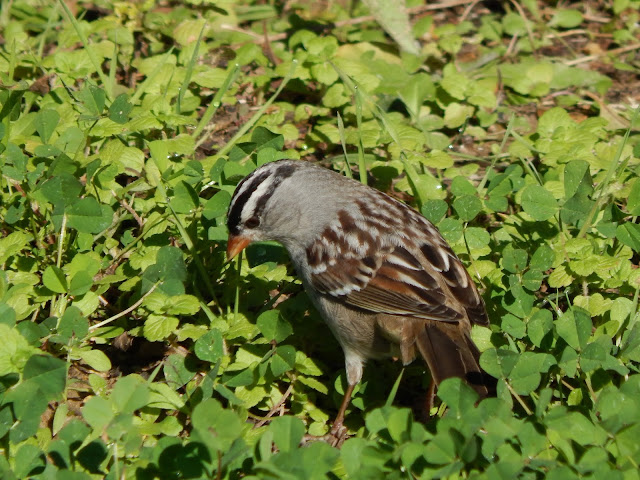
adult White-crowned Sparrow, Miller Oilfield Road
Three more Caracaras were visible north of the road. In the distance to the SE were visible numerous gulls swarming some promising spots on "Mount Trashmore" - the landfill hill that rises conspicuously from the flat terrain.
gulls at Jeff. Davis Parish landfill as seen from Miller Oilfield Road
    South on Turf Grass Road we encountered a hoard of Killdeer at the turf grass farm. In with them were a few other shorebirds such as Black-bellied Plover, Western Sandpiper, and Dunlin. The highlight, however, was a Long-billed Curlew. They aren't commonly encountered up in inland areas in the winter, so it was unexpected. We made sure to take a few photos and this short video of the bird.

   The next area, after an all-business drive down a few highways, was Wild Road, east of Hwy 99, south of the Bayou Chene bridge, about 6 miles south of Welsh. Conditions were pretty sunny and warming noticeably by this point (70-ish degrees f.?), though the breeze persisted. We spent an hour and a half along the short stretch of the road where the Pyrrhyloxia had been seen by numerous birders during December.
looking west along Wild Road from the Pyrrhuloxia spot
As said above, the PYRR was a no-show, but we ended up with a nice list to add to the hotspot. Bald Eagle, a pair of Inca Doves, a King Rail (heard only), and flyover (also heard only) Sandhill Cranes were some of the highlights. The King Rail - which I at first mistakenly thought was Clapper Rail, despite the wrong habitat - can be heard in this short video. While on foot at that locale, I found three butterfly species: Little Yellow, Gulf Fritillary, and Common Buckeye.
Little Yellow, Wild Road
Herps included Pond Slider, Blanchard's Cricket Frog, and Southern Leopard Frog. Eastern Fox Squirrel made sure the mammals didn't go unrepresented. Back on Hwy 99 just south of Wild Road we spotted a Caracara on the ground amid feathers, probably from a Snow Goose.

   After this, we birded while driving the Marceaux Road and Watkins Road area west of Hwy 99. Lots of distant shorebirds in rice fields along Marceaux, the closer ones included Long-billed Dowitcher and Western Sandpiper. There were some impressive groups of Snow Geese and Greater White-fronted Geese here as well.
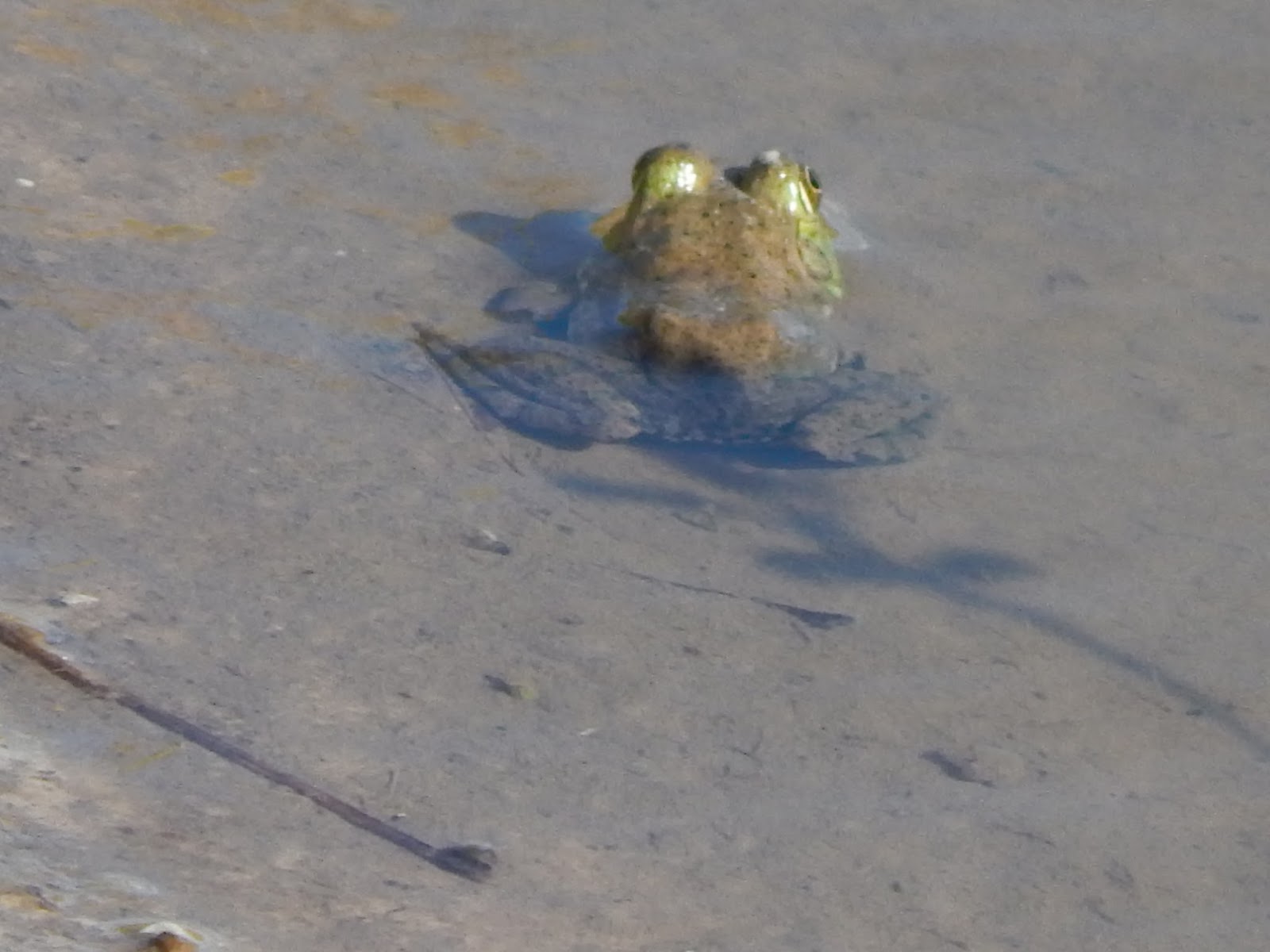
tentative i.d.: Pig Frog, near Hwy 14 west of Lake Arthur
American Alligator, Lacassine NWR, one of several gators seen that day
Lacassine Pool area of Lacassine NWR
   After attempts to find somewhere to bird west of Lake Arthur, we decided to head back west on Hwy 14 and visit the Lacassine Pool area of Lacassine NWR. Here, lots of American Coots and several duck species (including Gadwall, Mallard, Northern Pintail, Ring-necked Duck) bobbed in the open marsh pools as the wind continued to blow and the sky gradually began to get cloudy once again.
Neotropic Cormorant, Lacassine NWR

Gadwalls, cormorants, Ring-billed Gulls at Pintal Loop
 
   We went west from there to try for the Cinnamon Teal that had been seen at Cameron Prairie NWR. Though the teal eluded us, we got the day's final Crested Caracara, heard two more King Rails, and saw lots more coots and ducks.
American Coot flock, Pintail Loop, Cameron Prairie NWR
The wintery evening closed in as we headed back north. No Pyrrhuloxia. No Cinnamon Teal. But a great day of birding and a nice change of scenery and birdlife from our usual Cenla surroundings.
American Coots, Pintail Loop, Cameron Prairie NWR

Lantana - many were blooming along Pintail Loop
   I recommend a well-planned (look up what's been seen where on ebird and bring a good road atlas, at the least) trip to this part of southwestern Louisiana for any Louisiana birders who haven't already familiarized themselves with it. Lots to see.
   Below is a list of birds from that day, including birds seen while driving to and from the areas that we took the time to actually bird. Numbers of individuals aren't given as we didn't always keep track of that for casual observations.


Daylight hours in parts of Rapides (just passing through), Allen (just passing through), J. Davis, Cameron, and Calcasieu Parishes.

                                              (geese in video)
Greater White-fronted Goose
Snow Goose
Gadwall
American Wigeon
Mallard
Mottled Duck
Blue-winged Teal
Northern Shoveler
Northern Pintail
Green-winged Teal
Ring-necked Duck
Lesser Scaup
Ruddy Duck

Pied-billed Grebe

Neotropic Cormorant
Double-crested Cormorant
Anhinga
American White Pelican

Great Blue Heron
Great Egret
Snowy Egret
Little Blue Heron
Tricolored Heron
Cattle Egret
White Ibis
White-faced Ibis
pleg sp.
Roseate Spoonbill (video: Roseate Spoonbills foraging, Watkins Road)

immature Bald Eagle, Hwy 102 southeast of Fenton
Black Vulture
Turkey Vulture
Northern Harrier
Bald Eagle
Red-shouldered Hawk
Red-tailed Hawk

King Rail
Common Gallinule
American Coot

Sandhill Crane

Black-necked Stilt
Black-bellied Plover
Killdeer
Greater Yellowlegs
Lesser Yellowlegs
Long-billed Curlew
Dunlin
Western Sandpiper
Long-billed Dowitcher
Long-billed Curlew, Turf Grass Road

Ring-billed Gull

Eurasian Collared-Dove
Inca Dove
Mourning Dove

Belted Kingfisher

Red-bellied Woodpecker
Downy Woodpecker
Northern Flicker
Crested Caracara, Hwy 102 east of Fenton

Crested Caracara
American Kestrel

Eastern Phoebe

Blue Jay
American Crow
Fish Crow

Carolina Chickadee
Tufted Titmouse

House Wren
Carolina Wren

Blue-gray Gnatcatcher

Ruby-crowned Kinglet

Eastern Bluebird
American Robin

Gray Catbird
Northern Mockingbird

European Starling

American Pipit
American Pipit, Turf Grass Road

Orange-crowned Warbler
Common Yellowthroat
Yellow-rumped (Myrtle) Warbler

Chipping Sparrow
White-crowned Sparrow
White-throated Sparrow
Savannah Sparrow
Song Sparrow
Swamp Sparrow

Northern Cardinal
blackbirds (Red-winged Blackbird and Brown-headed Cowbird and possibly others), Hwy 102 southeast of Fenton

Red-winged Blackbird
Eastern Meadowlark
Common Grackle
Great-tailed Grackle
Great-tailed or Boat-tailed Grackle
Brown-headed Cowbird
blackbird sp.

American Goldfinch

House Sparrow
female House Sparrow, Hwy 102 southeast of Fenton
Pintail Loop, Cameron Prairie NWR, Cameron Parish