Thursday, October 23, 2014

Catahoula NWR HQ Unit, 10/16/14


Orchard Orbweaver
Tom and Brenda Pollock and I went to the Headquarters Unit of Catahoula NWR on October 16. Despite arriving at almost 9 o'clock, we still managed to get nearly 3 hours of good birding. Here are some details of the trip, photos, and the complete species count.
   We didn't get very much bird activity between the entrance and our first get-out-of-the-car stop at the north end of Duck Lake. However, we lucked up at the edge of the woods just before reaching the lake and got two FOS Ruby-crowned Kinglets. The list started to really grow by the lake -- a pair of American Kestrels, a Tricolored Heron, a Neotropic Cormorant, to name a few. We, however, didn't see any of the American White Pelicans at this particular spot, though they were here in the hundreds on the 14th. However, a hunter driving past stopped to chat briefly and said that he had seen large numbers of pelicans earlier.
North end of Duck Lake
We found a single American Coot in the cove that extends from the NW corner of the lake, going toward Cowpen Bayou.
   We continued west and south along the section of the refuge loop that parallels Cowpen Bayou. We made numerous stops, sometimes getting out for a short while. At one such stop, shadows of something large flying overhead while we were attempting to get decent photos of spiders/spider webs brought our attention skyward. 6 American White Pelicans! Well, its no 463, but that at least got them on the day's list. Among birds heard and seen along this section of the loop that were detected from the vehicle were a calling Blue-gray Gnatcatcher and a silent Eastern Wood-Pewee perched on a dead branch. Enthusiastic for Empidonax, we misidentified it as an Acadian Flycatcher when it got agitated and flew when it heard Acadian audio playback. Shameful, not knowing a Pewee when I see it, I know! haha. But, thanks to Dr. Remsen for correcting the mistake by looking at the photos and also pointing out that Empids aren't likely to be seen in the exposed perch hunting mode that the Pewee was in.
Eastern Wood-Pewee
 
Cowpen Bayou
   At another stop in this area Tom pointed out what would be our FOS Yellow-bellied Sapsucker. We also got Anhinga in Cowpen Bayou. Though very tough to find wintering in this area of the state in general, they can be found on practically every trip along Cowpen Bayou during the winter half of the year, if you keep your eyes open. Sometimes they'll be spotted on other parts of HQ during the wintering period as well. Of course, the species is very common during the summer half of the year.

Trail to the observation tower


   A walk down the trail to the observation tower at the SW corner of Duck Lake was rewarding. Along the trail we saw and photographed a number of Blanchard's Cricket Frogs. I have noticed that on some autumn days on the refuge, they can be seen, often in great numbers, hopping out of the way along the HQ unit's walking-only trails.


Blanchard's Cricket Frog, showing how effective their coloring
is at camouflaging them against the forest floor.

   There wasn't a lot of bird activity on the lake visible from the tower, but we did have an adult Bald Eagle circling almost directly above the tower itself. Swallows were flying about out over the lake and a couple of more pelicans were tallied.
   After that, we drove back the way we came, and found a decent sized American Alligator in the bayou, offering a nice photo op.
   All in all, a nice trip.

Complete bird species list for the day is below.
Blanchard's Cricket Frog, this one with a green pattern on its
back showing some of the variability in coloring found in this
common species.


American Alligator

Species list for 10/16/14
8:54 am to 11:51 am
Conditions: mild, clear, calm.
Birding driving approx. 5 miles of the 9 mile refuge loop, numerous stops, some stand around periods and short walks.

Wood Duck - 7
Northern Shoveler - 6

Neotropic Cormorant - 1
Double-crested Cormorant - 3
cormorant sp. - 2
Anhinga - 1
American White Pelican - 8

Great Blue Heron - 10
Great Egret - 6
Snowy Egret - 3
Tricolored Heron - 1
White Ibis - 2

Black Vulture - 1
Turkey Vulture - 10
Bald Eagle - 1 adult
Red-shouldered Hawk - 2

American Coot - 1

Killdeer - 4
Greater Yellowlegs - 3

Belted Kingfisher - 1

Red-bellied Woodpecker - 4
Yellow-bellied Sapsucker - 1
Downy Woodpecker - 1
Northern Flicker - 3
Pileated Woodpecker - 4

American Kestrel - 2 , a female and a male seen together

Eastern Wood-Pewee - 1
Eastern Phoebe - 7

White-eyed Vireo - 1

Blue Jay - 3
American Crow - 9

Northern Rough-winged Swallow - 1
Barn Swallow - 14
swallow sp. - 40

Carolina Chickadee - 20
Tufted Titmouse - 4

Carolina Wren - 8

Blue-gray Gnatcatcher - 1

Ruby-crowned Kinglet - 2

Northern Mockingbird - 1

Northern Cardinal - 14
Indigo Bunting - 4

Red-winged Blackbird - 30

passerine sp. - 1

   Recently, I've been focusing on Catahoula NWR on the blog, but I have some trips to other areas in this part of Cenla planned for the next few days or so. I look forward to blogging the results of those excursions, and hope to have some interesting finds, more First Of Season birds to report, and describing some unlikely but worth while places for birding and other nature-appreciation related activities.

Happy Birding!
Jonathan Clark

p.s.
Beware of Sky Spiders!
lol


Saturday, October 18, 2014

Catahoula NWR, First Half of October 2014


North end of Duck Lake
Its been a while since my last post, and there's a number of things that I'd like to get caught up on, but I think that first I should cover the trips to Catahoula NWR, HQ Unit for the first two weeks of October. October is a great time to bird this location, especially the month taken as a whole as one can see the shift from summer to winter avifauna quite dramatically over those particular 4 weeks or so.
   The trip for the first week of the month and the second will be handled separately within this blog entry, and each will have my species list from that day and a few photos. Here goes....

   10/3/14
   The air felt more-or-less like autumn, which is an encouraging sign. One expects to find new arrivals, FOS's, when birding a fall-like early October morning. I birded the nearer sections of the refuge loop, driving first on the north side as far as the corner by Cowpen Bayou and including a long time standing around by the north end of Duck Lake. After that I backtracked and took the east leg south and turned around at the right-of-way that turns off the west side of the road, showing Duck Lake in the distance.
   Some summer birds still holding strong, and evidence of southward migration by neotrops was in evidence. Also, though, a few FOS winter species had finally arrived.

Eastern Fox Squirrel foraging on the ground.
   This was also the day before the opening day of squirrel season, and the abundant Eastern Fox 
Squirrels (Eastern Gray Squirrels seem not to inhabit the woods of the HQ unit) seen that day would be undetected on the next week's trip. The beginnings of last year's squirrel season fell during the government shutdown, and as a result the extremely high numbers of hunters that normally flock to this locale for the opening weekend weren't able to hunt it. This has lead to a robust squirrel population at this location over this past year. I should clarify that I am not anit-hunting in general, but it is very interesting to note that the excessive hunting pressure that marks most early Octobers on the HQ unit does have an unduly strong effect on the resident squirrel population, making it often seem somewhat small relative to the truly excellent quality of the habitat.


Eastern Fox Squirrel
Species list for 10/3/14:
8:50 am to 10:02 am.
Conditions were 72 to 74 degrees f., light breeze to near calm, cloudy. Water level marker at north end of Duck Lake showed 34.2 feet.
Traveled 2.4 miles with numerous stops, long stand-around period at north end of Duck Lake.

Blue-winged Teal - 23
Northern Shoveler - 7
duck sp. - 30

White Ibis
Pied-billed Grebe - 1

cormorant sp. - 1

Great Blue Heron - 3
Great Egret - 5
Snowy Egret - 1
Little Blue Heron - 2
Tricolored Heron - 4
White Ibis - 21
Roseate Spoonbill - 1

Black Vulture - 2
Turkey Vulture - 5
Cooper's Hawk - 1 (FOS)
Bald Eagle - 1
Red-shouldered Hawk - 2

peep sp. - 4
Yellow-billed Cuckoo
Yellow-billed Cuckoo - 1

Red-bellied Woodpecker - 6
Downy Woodpecker - 2
Northern Flicker - 2
Pileated Woodpecker - 2
Downy Woodpecker

American Kestrel - 1


Eastern Wood-Pewee - 1
Eastern Phoebe - 1 (FOS)


Eastern Wood-Pewee (previously misidentified as Empidonax sp.)

White-eyed Vireo - 6

Blue Jay - 5
American Crow - 2
crow sp. - 3

Carolina Chickadee - 6
Tufted Titmouse - 2

Carolina Wren - 9

Easter Bluebird - 2


A closer look at the Eastern Wood-Pewee


Gray Catbird - 1

Northern Cardinal
Brown Thrasher - 1

Nashville Warbler - 1 (FOS)
Common Yellowthroat - 3
Hooded Warbler - 2
American Redstart - 3
Northern Parula - 3

Northern Cardinal - 12
Blue Grosbeak - 1
Indigo Bunting - 5


Indigo Bunting


Red-winged Blackbird - 50

passerine sp. - 2


*****************************************************************************

10/14/14

North end of Duck Lake, showing some of the pelicans present.

  It was one of those cool, crisp mornings when you just know that its autumn. Bird activity was fairly good. The only non-avian wildlife observed (not counting the fish activity on the lake) was a young American Alligator in the slough that flows into / out of Duck Lake. No squirrels seen or heard along the road. I birded driving a short section of the refuge loop from entrance to my usual parking spot by the north end of Duck Lake (about 1.1 mile). A number of short stops, and a long stand around period at north end of the lake.
   The hoard of American White Pelicans that greeted me when I got near the lake was quite a sight. There were significantly more than I am used to at this locale. Also nice was a first year Lark Sparrow spotted along the road at the north end of the lake and a Sharp-shinned Hawk cruising the wood line by the NW corner of the lake. Both of those were FOS.
American White Pelican

Species list for 10/14/14:
7:16 am to 9:01 am
Conditions were 55 to 59 degrees f., clear, near calm to light breeze. Water level marker at north end of Duck Lake showed 34.3 feet.
Traveled 1.1 mile.

Wood Duck - 7
Northern Shoveler - 3
Blue-winged Teal - 7
duck sp. - 1

Neotropic Cormorant - 1
Double-crested Cormorant - 2
cormorant sp. - 1
American White Pelican - 463
American White Pelicans


Great Blue Heron - 4
Great Egret - 23
Snowy Egret - 4
Little Blue - 1
Tricolored Heron - 3
Great Blue Heron

White Ibis - 2
Roseate Spoonbill - 29


Black Vulture - 15
Turkey Vulture - 2
Sharp-shinned Hawk - 1 (FOS)
Red-shouldered Hawk - 3

Killdeer - 1
Greater Yellowlegs - 3
peep sp. - 4
Dowitcher sp. - 90
shorebird sp. - 12

Mourning Dove - 1

Red-bellied Woodpecker - 2
Downy Woodpecker - 1
Northern Flicker - 2
Pileated Woodpecker - 2

Eastern Phoebe - 1

Blue Jay - 3
American Crow - 3
Fish Crow - 1

Northern Rough-winged Swallow - 2
Tree Swallow - 9
Barn Swallow - 12
Swallow sp. - 50

Carolina Chickadee - 9

Eastern Meadowlark
Carolina Wren - 3

Eastern Bluebird - 1

Common Yellowthroat - 2

Lark Sparrow - 1 (FOS)

Northern Cardinal - 6
Indigo Bunting - 5

Red-winged Blackbird - 55
Eastern Meadowlark - 1


American White Pelicans


Coming up over the course of the next few days I'll be putting up several new blog posts, catching up to the present and including some material from the last couple of months that I've neglected to cover. Included will be one for the trip that Tom and Brenda Pollock and I took to the Catahoula NWR HQ Unit on 10/16/14.

Happy Birding!
Jonathan

Wednesday, September 24, 2014

A Grant Parish Gem: The Catahoula Hummingbird and Butterfly Garden (9/10/14)

  
Pond at the Butterfly Garden (photo: J. Clark)


   I'm grateful to Tom Pollock for introducing me to The Catahoula Hummingbird and Butterfly
Garden. Being a Grant Parish resident, and in fact one of the garden's Active Gardeners, Tom is a regular at this location in the Kisatchie National Forest on FR 145, off  the south side of highway 8 between Pollock and Bentley.


"Trail's" Flycatcher (photo: J. Clark)
   Though it was a warm, breezy mid-to-late morning, and wildlife activity was not at it's highest by any means, our trip proved to be fruitful. Upon getting out of the vehicle at the garden's parking area, we were immediately made aware of several bird species including a flycatcher active in the area adjacent to the bat house. The bird proved to be a "Trail's" Flycatcher,


the umbrella name for two notoriously difficult to distinguish species: the Alder and Willow Flycatchers. Soon, a juvenile Chipping Sparrow was noticed. It would prove to be one of a family group of Chippers present around the garden.

 
Cloudless Sulphur, photo by T. Pollock
 
A look at the informative signage before entering the garden is suggested to any visitor and should prove useful. This is especially true if, like myself, one isn't very familiar with butterfly identification. The garden itself is a system of well maintained trails weaving trough diverse and dense beds of flowers. Butterflies. Goodness, the butterflies! Cloudless Sulphurs were probably the most abundant single species, though numerous species were present.
   Though hummingbirds were not so common, two female Ruby-throated Hummingbirds were observed. The small pond, with its waterfall and bamboo gazebo, forms a wonderful focal point of the garden. Though silent at the time, Tom informed me that Southern Leopard Frogs chorus here, and indeed it seems a good spot for a number of anuran species to spawn. Watch your step, too, as Cottonmouths are regularly seen around the pond and adjacent areas. In fact, we saw a juvenile Cottonmouth in the pond.

Gulf Fritillary, photo by T. Pollock

photo by T. Pollock
   Though the Red-cockaded Woodpeckers that roost in the longleafs beside the garden were gone from the location by that time of the morning, we did get a look at one of the Gray Catbirds. Though not detected this day, Bachman Sparrows are common in the fine mature pine forests just a short walk from the garden. A trip there on a spring morning will let one hear their musical songs.


morning glory, photo by J. Clark

   Short drives further down the road past the garden and on the nearby Stuart Lake Road didn't yield much in the way of birds or other wildlife, the scenery of mature Longleaf Pine woods was a nice experience in and of itself.
Longleaf Pine forest along Stuart Lake Road,
photo by J. Clark
   I look forward to many future trips to The Catahoula Hummingbird and Butterfly Garden, most especially when spring comes around.
photo by J. Clark

Sunday, August 17, 2014

Farther Afield: 8/14/14 Trip To Cameron Parish Including Birds Along The Way.

Royal Terns and Least Tern, Holly Beach, Cameron Parish.
   On August 14, Tom Pollock, Jay Huner, and myself embarked on a trip to the birding wonderland that is Cameron Parish, Louisiana. Ok, so that's the southwest corner of the state and not Cenla, but its hard to resist doing a blog on a trip to such an excellent birding location. Besides, we traveled through parts of central Louisiana on the way there and back and a few mentionables were picked up here in Cenla.

   One of the first few species of the day were a flyover flock of Wood Storks spied along highway 121 between I-49 and highway 1200 in northwestern Rapides Parish. Minutes later (admittedly after missing our turn and continuing on on 121/1200) Tom Pollock and I spotted an adult Scissor-tailed Flycatcher on highway 1200/121 south of their junction.

   The drive down to Cameron had a host of species as roadside birds, but all were more-or-less what's normal in their areas. It is interesting to note, however, how what 'normal' is shifts as we move further south and out of the woodland zone and into the prairie region, and then into the coastal marshes.

   ***A stop by the exit at Sulphur at Lebleu's for the traditional boudin and cracklins.***
and now back to the show...

Swamp Rabbit (juvenile), Sabine NWR.
   Shortly after entering the marshes on hwy 27 south of Sulphur, one enters Cameron Parish. Widely recognized as one of the best birding areas, if not the best birding area in the state in terms of sheer diversity possible on a given day and in terms of quantity of individuals of some species, and in the likelihood of encountering a rarity or five. One of the first birds of note that day was a flyover Least Bittern in the marshes along highway 27. Admittedly, that was a lifer for me, and (if meticulous Tom chooses to count it) a lifer for Tom as well. We stopped for a short while at the Sabine NWR wetland walkway and I got a look through binoculars at another Least Bittern that flew up from cover and disappeared around the bend of the channel. Unfortunately, Tom didn't get to see it. When out birding, keep an eye out for the other wildlife around. By the parking lot at the wetland walkway were an adult and juvenile Swamp Rabbit that were unusually tame and allowed for a few nice photos.


   As we approached the fork in the road at Holly Beach, the excitement builds. Will there be a rare gull on the beach? A pelagic species visible over the water? We drove the vehicles-permitted part of the beach starting near the east side of Holly Beach, and working our way west of the village. No true rarities, but a Snowy Plover almost right off the bat was nice. Also, there was a nice variety of terns, at least from my inland point of view. The requisite Royal Terns were the most abundant, but there were also a small number of Caspians. The tiny Least Terns were in good numbers, looking like ragdoll versions of their much larger cousins. Among the small terns was also a nice presence of Black Terns. A few Gull-billed Terns were a nice spice to the gumbo, as were a small number of Forster's Terns. All gulls in this area were the ubiquitous Laughing Gulls, and there were p-len-ty of them! Oh yeah, and careful not to run over any of the Sand Crabs running hither-and-thither across the beach!


Reddish Egret, west of Holly Beach, Cameron Parish
   From there, it was westward ho! along Highway 82 to Peveto Woods Sanctuary. Along the way there were lots of gulls, terns, Brown Pelicans, Sanderlings, Willets, and a few other expected species along the beach. We scanned the birds around a distant fishing boat, but no unusual pelagic species could be sussed out, just the usual Brown Pelicans and a few "gull sp.". We did, however, find a lot of terns, Laughing Gulls, Brown Pelicans, and the expected shorebirds along the beach. Along side them were two Reddish Egrets, a life list first for me. When we arrived at Peveto Woods Dave Patton was there doing trail maintenance and other work. This would be a good place to express some thanks to Mr. Patton for the work he does there. Thanks! Also worth a thank you, he filled us in on the birds he'd found that morning. One, the Olive-sided Flycatcher, would be a lifer for me and he lead us directly to it before parting ways to return to his work. The Olive-sided was cooperative enough that we got a few pictures and a good, clear look at the bird. Mr. Patton also mentioned "Trail's" Flycatchers and Yellow Warbler as having been there that morning, but we didn't relocate them on our walk around the trails of the sanctuary around midday. We did, however, pick
Olive-sided Flycatcher, Peveto Woods Sanctuary, near Johnson's Bayou, Cameron Parish
up the Painted Buntings, Orchard Orioles, Blue-gray Gnatcatchers, and Eastern Kingbirds that he had mentioned. Also among woodland birds present on the chenier was a Downy Woodpecker. Two wing feathers from an owl; presumably Great Horned, but MAYBE Barn, were found on the ground. Among the more interesting finds to me was the Six-lined Racerunner that I spotted. I'm used to encountering this lizard species on sandy roads through piney woods and cutovers back in cenla. It was interesting to me to see them in this setting, within earshot of the waves on the gulf beach. Also on the reptile front, Dave had seen a Cottonmouth while working. So, watch your step, folks!
  
   ***From there, it was westward on highway 82 to the gas station/store/restaurant by the school in Johnson's Bayou. The burgers are so good!***

   Then westward along Highway 82 to the waters east of the Sabine Pass bridge to hopefully get American Oystercatcher. No such luck, but we did get Herring Gull. We turned around and headed back east on hwy 82 toward Holly Beach. Along the way, we spotted a Mottled Duck in a pond or marshy patch on the north side of the road. Tom spotted a Common Nighthawk in flight, which I missed (don't recall if Jay saw it or not). Fortunately that was not the last of the Nighthawks. At a couple of spots close to one another a little east of the flying bird, we saw several nighthawks, all presumably Common, perched on the posts of the wooden fence that parallels the highway between the highway and the beach. Either we missed them on our earlier pass or they'd arrived in the interim.
Juvenile Laughing Gull "guarding entrance to Cameron Ferry"


Reddish Egret, East Jetty, Cameron Parish
   Holly Beach to the Cameron Ferry on Highway 82/27 didn't give us anything unusual. While waiting for the ferry, at least two different Northern Cardinals were seen a number of times flying across the road from one group of trees/bushes to the other. Dolphins in the Calcasieu and the usual terns, Laughing Gulls, and Brown Pelicans flying above, and the comical Boat-tailed Grackles at either shore made the wait and crossing enjoyable.


Green Heron, East Jetty, Cameron Parish
   Davis Road between the village of Cameron and the East Jetty Park didn't yield up anything unusual, but there's still plenty of birdage to be had. East Jetty Park itself, including the beach, was as always a strong birding experience. Reddish Egret, Green Heron, and Ruddy Turnstone were very
Ruddy Turnstones, East Jetty, Cameron Parish
cooperate when it came to taking photos. I flushed a Clapper Rail and heard another calling in the small area of tall grass near the jetty rocks north of the beach. The beach itself was a pleasant sight to behold. Barn Swallows swooped and swarmed, sometimes passing nearly within arms reach. This year's young terns, Least and Royal, called on the beach as mom and dad came and went on their quest to supply their progeny with fresh fish. Brown Pelicans and Laughing Gulls
glided overhead and landed on the beach. Herons and egrets danced in the surf and porpoises breached here and there in the mouth of the Calcasieu River. Other than the, *ahem*, aroma of the organic mater that one finds rotting on such beaches, it was a very enjoyable experience. The kind of thing that this birder gets a kick out of.


Terns, gull and plover at East Jetty Beach, Cameron Parish.
(Upper left and center right) Laughing Gull; (center) Royal,
Black, and Least Terns; and (lower right) Wilson's Plover.


   Back in Cameron itself, we had Eurasian-Collared Dove and White-winged Dove. From there, we continued east on hwy 82/27, took the north fork at the split, and then north on highway 27 through the marshes and over the intercoastal waterway.
Common Gallinule (adult), Pintail Loop, Cameron Prairie
NWR, Cameron Parish

   We made the loop at Pintail Loop on Cameron Prairie NWR. As always, this was full of wonderful, up-close birding. Family after family of Common Gallinules could be found, often quite tame. Several Fulvous Whistling-Ducks, including an adult with young juveniles were seen. Ibises, Black-necked Stilts, Tricolored Herons, and other wading birds and shorebirds dotted the impoundments. American Alligator was present in abundance, and one was seen dangerously close to Common Gallinules until they scattered as we drove past. The adult Purple Gallinule with two fluffy, all-black juveniles gave us a challenging photographic experience as they bobbed and weaved through the grass at the water's edge near the road. Several more Purples were seen after that. At least one American Coot and a small number of Pied-billed Grebe were seen in the water and a Mottled Duck or two as flyovers.

Purple Gallinule (adult), Pintail Loop, Cameron Prairie
NWR, Cameron Parish


   After Pintail Loop, it was north on hwy 27 to the headquarters area of Cameron Prairie NWR. At least three Red-bellied Woodpeckers were present in the trees on the south side of the parking area, Common Gallinules and American Alligators were hanging out in an accustomed-to-humans sort of way in the little pond by the parking lot and office building, and a Red-tailed Hawk was seen from the observation tower/boardwalk area.


Juvenile Purple Gallinule "walking on water", Pintail Loop,
Cameron Prairie NWR, Cameron Parish.
   We continued north on hwy 27, then east on Chalkley Road where there was a sudden flurry of Scissor-tailed Flycatchers, adult and juvenile, present along the road side fences and power lines. There were enough for two or three family groups. We continued the route, taking Arceneaux Road north where rice harvesting was underway. Lots of House Sparrows, Common Grackles, and others were gathered here. Then east on Pine Pasture Road which runs along the Cameron-Calcasieu Parish line. No Crested Caracaras. Well, we can't have everything, can we?

   We left Cameron Parish going north on Fruge Road (Eastern Meadowlark, lots of Brown-headed Cowbirds) and made our way to the town or Iowa, then north on highway 165, taking us, after a good while, back to cenla.  Along the way I spotted a pair of Black-bellied Whistling-Ducks fly over highway 165 north of Fenton.

   Though this was not the most bird-packed of my meagre three trips to Cameron, all of them this year, there seems to be no bad time to go to this place. Always something to see, often something really exciting (from a birder's perspective, at least) to be found. I highly recommend that any Louisiana birder who hasn't made the pilgrimage to good ol' Cameron-by-the-Sea, do so. Research on ebird or elsewhere, ask around among birders who know the area well, and check out things like parish checklists. A well planned and well timed trip to Cameron Parish should yield a memorable birding experience, and you'll probably find yourself looking forward to your next trip there.
Wind-sculpted Live Oaks near Peveto Woods Sanctuary.

...Me personally, I miss the Great-tailed and Boad-tailed Grackles. Those things are everywhere down in that part of the state! : )

A complete list of species from our time in Cameron Parish on 8/14/14 is below.


Fulvous Whistling-Duck adult with young, Pintail Loop,
Cameron Prairie NWR, Cameron Parish.
Fulvous Whistling-Duck
Mottled Duck

Pied-billed Grebe

Wood Stork
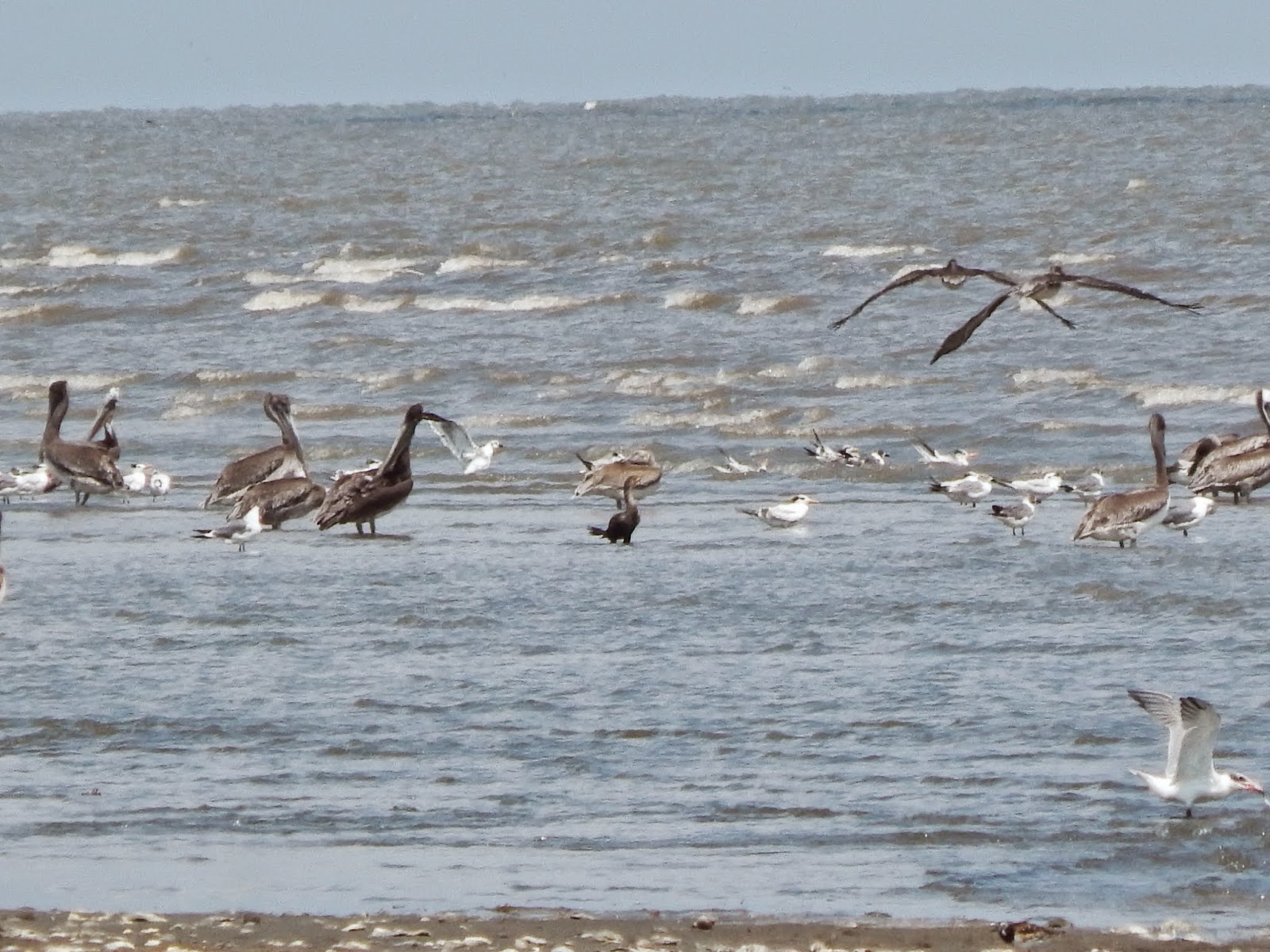
 
Brown Pelicans, Double-crested Cormorant, Ruddy Turnstone,
Laughing Gulls, and Royal Terns.
 East Jetty Beach, Cameron Parish

Neotropic Cormorant
Double-crested Cormorant
Anhinga
Brown Pelican


Least Bittern
Great Blue Heron
Great Egret
Snowy Egret
Little Blue Heron
Tricolored Heron
Reddish Egret
Cattle Egret
Green Heron
White Ibis
Juvenile Common Gallinule, by boardwalk behind headquarters
Cameron Prairie NWR, Cameron Parish.
pleg. sp.
Roseate Spoonbill

Black Vulture
Turkey Vulture

Clapper Rail
Purple Gallinule
Common Gallinule
American Coot
 
Black-necked Stilt
Snowy Plover
Wilson's Plover, west of Holly Beach, Cameron Parish.
Wilson's Plover       
Killdeer
Spotted Sandpiper
Willet
Ruddy Turnstone
Sanderling

Laughing Gull
Herring Gull
Least Tern
Gull-billed Tern
Caspian Tern
Black Tern
Forster's Tern
Royal Tern
Gull-billed Tern, Holly Beach, Cameron Parish.


Eurasian Collared-Dove
Inca Dove
White-winged Dove
Mourning Dove

Common Nighthawk

Red-bellied Woodpecker
Downy Woodpecker
 
Downy Woodpecker, Peveto Woods Sanctuary,
Cameron Parish.

Olive-sided Flycatcher
Eastern Kingbird
Scissor-tailed Flycatcher

Loggerhead Shrike

Blue Jay
Fish Crow
crow sp.

 
Purple Martin
Barn Swallow

Marsh Wren

Blue-gray Gnatcatcher

Northern Mockingbird

European Starling

Common Yellowthroat
Common Yellowthroat, Sabine NWR, Cameron Parish.


Northern Cardinal
Painted Bunting

Red-winged Blackbird, Sabine NWR, Cameron Parish
Red-winged Blackbird
Common Grackle
Boat-tailed Grackle
Great-tailed Grackle
Orchard Oriole

House Sparrow


Other Wildlife Encountered:

Blanchard's Cricket Frog
Pig Frog

American Alligator, Pintail Loop, Cameron Prairie NWR.


American Alligator
Six-lined Racerunner
Swamp Rabbit (adult), Sabine NWR, Cameron Parish.
Pond Slider

Swamp Rabbit 
dolphin sp.
porpoise sp.


Juvenile Common Gallinules, Pintail
Loop, Cameron Prairie NWR.

American Alligator, Cameron Prairie
NWR Headquarters. Cameron Parish.
Thanks for reading! A new series of posts focusing on some of the cenla quads covered in the Louisiana Bird Atlas will be coming soon......


Happy Birding!
Jonathan Clark