Wednesday, June 10, 2015

Catahoula NWR, May 2015

Cedar Waxwings, Catahoula NWR Willow Lake Unit. 5/2/2015
A bit late, but here's a summary of birding on Catahoula NWR for the month of May, 2015. This includes highlights for five lists from three days, all in the first half of the month. Hope you find it informative.


5/2/15 - Willow Lake Unit and Headquarters Unit

   Tom Pollock and I made a trip to the refuge on the morning of May 2nd . First to Willow Lake Unit, then Headquarters Unit. On Willow, we got quite a strong list of species for a short drive. An immature Sharp-shinned Hawk, a bit late in the season for its kind, landed in the gravel road ahead of us, flushing the cowbirds and Mourning Doves that it was presumably stalking. The little raptor stayed long enough for us to snap some diagnostic photos.
Sharp-shinned Hawk, Catahoula NWR Willow Lake Unit, 5/2/15
   A little further along, where a side road turns off to the south, we got Northern Waterthrush. The species had been seen very close by on my previous trip and a little brownish bird seen flying into the bushes along the ditch/swampy area was enough to get us to pay close attention. Sure enough, it turned out to be a N. Waterthrush.
Cedar Waxwing, Willow Lake Unit
   Along the road, we could hear the Sedge Wrens still present in the tall grass. The usual breeding species that had already been noted as arriving on the WL Unit were in evidence (Painted and Indigo Bunting, Orchard Oriole, Prairie Warbler, YB Chat, etc.).
   Cedar Waxwings were still hanging around where I'd seen them on other recent trips. This time some of the flock perched in branches right along the road where we parked and gave us a chance to get some decent pictures of these handsome songbirds.
Cedar Waxwing, Catahoula NWR Willow Lake Unit, 5/2/2015

   At the slough down the walking-only path, past the west corner of the main road, we spotted what turned out to be a male Ring-necked Duck sitting in the grass beside the water. Tom got out and walked to get a better look while I snapped some distant pics from the vehicle in case the bird should fly. The RN Duck didn't fly, but instead walked to the water and swam away. Tom, however, was focused on photographing another surprise -- in the slough were three Canvasbacks (one female, two male.) Both duck species were at the late end of when they are expected to be found in the area, and the little slough where they were is not the most typical habitat for either species.

male Tennessee Warbler, Catahoula NWR Headquarters Unit, 5/2/2015

Little Underwing, Catahoula NWR HQ Unit
   The good birding continued at the Headquarters Unit. Migrants weren't as concentrated as they sometimes are, but we did get several neotrops that don't breed in the area -- lots of Tennessee Warblers and one each of Chestnut-sided  and Magnolia Warblers -- and a Black-and-white Warbler, which breeds in the area but isn't known to do so at this location. A Lincoln's Sparrow was a nice find, the second one of the day (the first being on Willow Lake Unit).
   Numerous wildflowers were in bloom, attracting butterflies. I got pics of a Pipevine Swallowtail butterfly and a Little Underwing moth in the roadside grass and flowers. Many thanks to Rosemary Seidler for correctly i.d.-ing the moth for me, as I am very much a novice at Lepidoptera  identification.
Little Underwing, Catahoula NWR HQ Unit, 5/2/2015

Barred Owl, Catahoula NWR HQ Unit, 5/2/15
   I decided to do a few Barred Owl calls at a spot along the east leg of the refuge loop, and a moment later we had a pair of the owls checking us out with a third individual heard responding in the distance.
   A Spotted Sandpiper was a nice day bird. It was hanging out by the first of the three 'big culverts' when driving south on the east leg of the refuge loop. Near one of the other three culverts we spotted a Common Gallinule. Though they do breed at some locations in the La Salle and Catahoula Parish area, this is the first gallinule that I've seen on the HQ unit of the refuge.


Common Gallinule, Catahoula NWR Headquarters Unit
   As we traveled north along the west side of the loop, the part following Cowpen Bayou, we continued to get lots of the usual summer birds, as we had throughout the morning. These include Mississippi Kite, Painted and Indigo Buntings, Prothonotary and Kentucky Warbler and Northern Parula, Red-eyed and White-eyed Vireos, Acadian Flycatcher, and many more. A Yellow-throated Warbler on the banks of the bayou was a nice bird to see. Though they - along with the Parula and Prothonotary - are regular breeders along Cowpen Bayou, the Yellow-throateds do seem to be by far the least common of the three.


Prothonotary Warbler singing at possible nest cavity, Cowpen Bayou,
Catahoula NWR HQ Unit, 5/2/2015
Green Anole, Catahoula NWR HQ Unit, 5/2/15


   At the north end of the lake there was a Tree Swallow seen entering a cavity in one of the potential nest snags out in the water. The bird, however, hasn't been seen there in my subsequent trips during May.
  

displaying male Green Anole (brown phase),
Catahoula NWR Headquarters Unit, 5/2/15


                                                                               Other wildlife, besides birds, included a variety of anurans including Blanchard's Cricket Frog, Green Treefrog, Green Frog, and American Bullfrog. There were two reptile species identified - Green Anole and Pond Slider, and one mammal species - Eastern Fox Squirrel.


male Green Anole (green phase), Mosquito Bend Rd. and Cowpen Bayou, Catahoula NWR HQ Unit, 5/2/15
   We finished the day with a total of 38 bird species on Willow Lake Unit and 56 bird species on the Headquarters Unit. The complete lists for those two, respectively, are below, followed by the account for May 12th.
..........................................................................................................................
Catahoula National Wildlife Refuge, Willow Lake Unit

La Salle Parish

5/2/2015

7:00 am - 8:41 am

Conditions: mild, near calm, sunny

Protocol: driving, 1.3 miles, numerous stops

Wood Duck - 2
Canvasback - 3
Ring-necked Duck - 1
male Ringed-necked Duck, Catahoula NWR
Willow Lake Unit, 5/2/15

Anhinga - 1

Great Blue Heron - 1
Snowy Egret - 2

Sharp-shinned Hawk - 1

Mourning Dove - 6

Yellow-billed Cuckoo - 2

White-eyed Vireo - 4

American Crow - 1

Barn Swallow - 2

Tufted Titmouse - 1

Sedge Wren - 7
Carolina Wren - 3

Gray Catbird - 1

Cedar Waxwing - 30
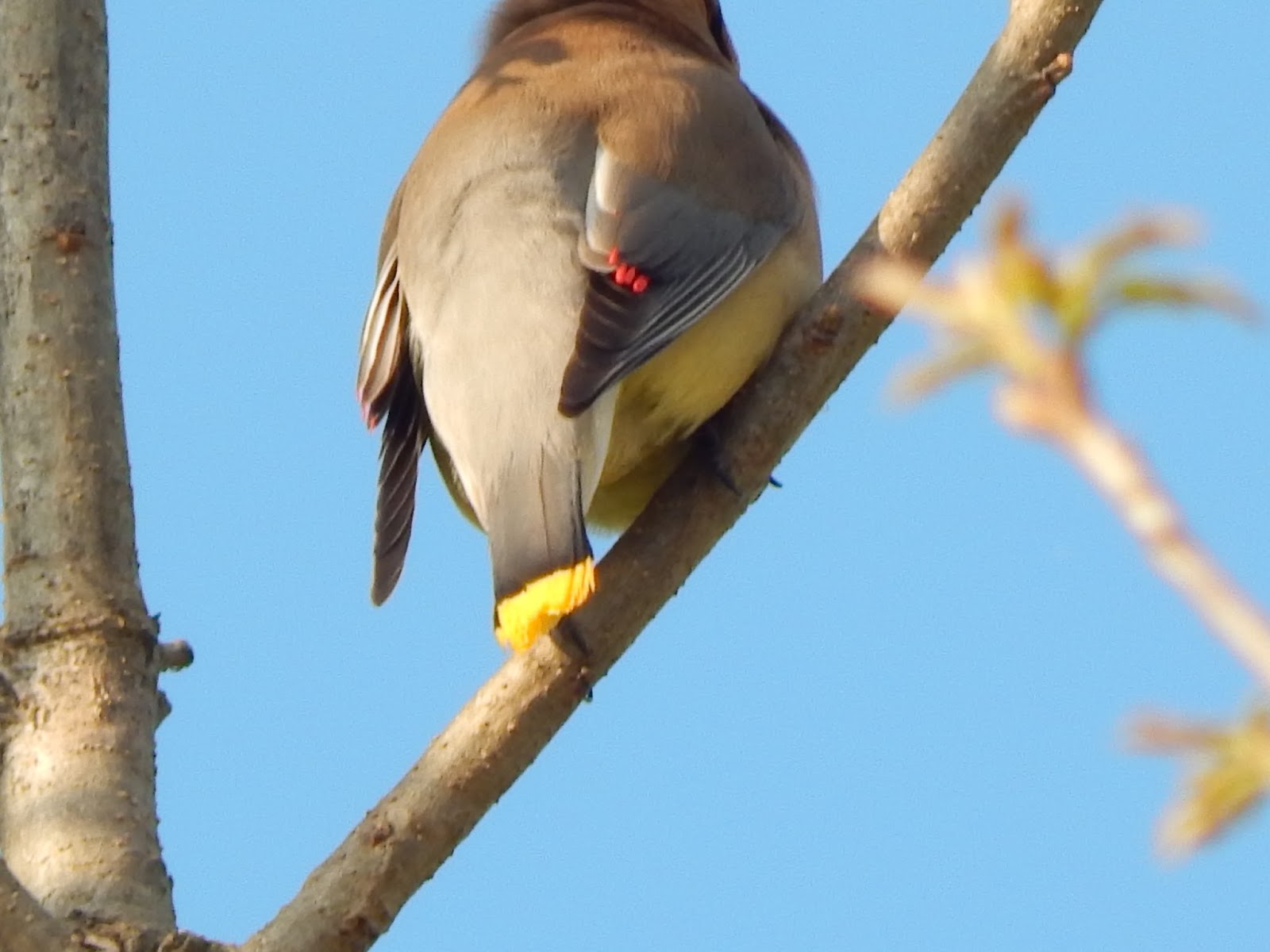
Cedar Waxwing showing the red "drops of wax" that give the species its name. Catahoula NWR Willow Lake Unit

Northern Waterthrush - 1
Prothonotary Warbler - 2
Kentucky Warbler - 1
Common Yellowthroat - 4
Hooded Warbler - 3
Northern Parula - 1
Prairie Warbler - 4 (1 female, 3 males)
Yellow-breasted Chat - 7

Eastern Towhee - 2
Lincoln's Sparrow - 1
Swamp Sparrow - 3
male Northern Cardinal, Catahoula NWR Willow Lake Unit
Summer Tanager - 1
Northern Cardinal - 8
Blue Grosbeak - 3
Indigo Bunting - 16
Painted Bunting - 7

Red-winged Blackbird - 5
Eastern Meadowlark - 1
Common Grackle - 1
Brown-headed Cowbird - 10
Orchard Oriole - 4


........................................................................................................................
Catahoula NWR, Headquarters Unit

La Salle Parish

5/2/2015

8:44 am - 1:17 pm

Conditions: warm, sunny, some light breeze. Water level marker at north end of Duck Lake showed approx. 40 feet.

Protocol: driving, 9.5 miles (entire refuge loop plus Mosquito Bend Road), numerous stops and stand-around periods.

Double-crested Cormorant - 1
Anhinga - 4

Great Blue Heron - 4
Great Egret - 8
Snowy Egret - 3
Little Blue Heron - 2
Green Heron - 1
Mississippi Kite, Catahoula NWR HQ Unit

Black Vulture - 1
Turkey Vulture - 5
Mississippi Kite - 3
Red-shouldered Hawk - 1
Red-tailed Hawk - 2

Common Gallinule - 1

Spotted Sandpiper, Catahoula NWR HQ Unit
Spotted Sandpiper - 1

Mourning Dove - 4

Yellow-billed Cuckoo - 1

Barred Owl - 3

Ruby-throated Hummingbird - 2

Red-bellied Woodpecker - 12
Downy Woodpecker - 6
Pileated Woodpecker - 2


Acadian Flycatcher, Catahoula NWR HQ Unit
Eastern Wood-Pewee - 2
Acadian Flycatcher - 8
Great Crested Flycatcher - 1

White-eyed Vireo - 8
Red-eyed Vireo - 24

Blue Jay - 1
American Crow - 3

Tree Swallow - 1
Barn Swallow - 1

Carolina Chickadee - 4
Tufted Titmouse - 11

Carolina Wren - 14
male Black-and-white Warbler, Catahoula NWR HQ Unit
Blue-gray Gnatcatcher - 11

Gray Catbird - 7

Black-and-white Warbler - 1
Prothonotary Warbler - 21
Tennessee Warbler - 24
Kentucky Warbler - 2
Common Yellowthroat - 1
Northern Parula - 7
Magnolia Warbler - 1
Chestnut-sided Warbler - 1
Yellow-throated Warbler - 1
Yellow-breasted Chat - 4

Eastern Towhee - 2
Lincoln's Sparrow - 1
Lincoln's Sparrow, Catahoula NWR HQ Unit

male Orchard Oriole, Catahoula NWR HQ Unit
Summer Tanager - 20
Northern Cardinal - 19
Blue Grosbeak -1
Indigo Bunting - 55
Painted Bunting - 35

Red-winged Blackbird - 10
Common Grackle - 14
Brown-headed Cowbird - 20
Orchard Oriole - 12
male Orchard Oriole, Catahoula NWR Headquarters Unit, 5/2/15

Pipevine Swallowtail on Vetch blossoms, Catahoula NWR HQ Unit

*******************************************************************
5/12/15 - Headquarters Unit and Willow Lake Unit


female Painted Bunting,
Catahoula NWR HQ Unit
male Painted Bunting,
Catahoula NWR HQ Unit
   Hoping that conditions were right for some spring migrants to be
seen, I headed out to the refuge. I did a short section of the loop on the HQ unit, starting with the traditional neotrop hotspot on the east leg of the loop, just south of the fork past the HQ building/hunter sign-in. I'm afraid there wasn't much (or any) transient neotrop activity to see, but this did free up my attention to notice the details of the flurry of activity from the breeding birds. Twice I watched the mating behavior of a pair of Painted Buntings, though I didn't see copulation in either instance. I did watch the 'flirtatious' posturing of the female and the excitement this caused in her mate.
American Goldfinch, Catahoula NWR HQ Unit
   The usual sorts of birds were noted at the north end of Duck Lake, but the highlight of the day was at the NW corner of the loop beside Cowpen Bayou. I stopped for a listen from the truck and heard an American Goldfinch calling from nearby. A scan of the adjacent trees showed the bird to be perched at the edge of the road clearing. Soon, it came down to get grit from the gravel road. The bird was not only late season in the area for its species, but it had a damaged or deformed bill. I was able take numerous photographs from close range, and the condition of the bill is clearly shown in many of them. The bird seemed otherwise plump and healthy, so hopefully the unusual state of the bill was not a hindrance to its ability to feed itself.
American Goldfinch, Catahoula NWR HQ Unit, 5/12/2015
  
After leaving the HQ Unit, I made a visit to Willow Lake Unit.

   There was little changed from the previous trip to WL Unit, except that all winter species, with the exception of Cedar Waxwing, seemed to have finally departed for there breeding grounds up north. In other words, no more Swamp Sparrows or Sedge Wrens. There were, however, several frog species heard, including Blanchard's Cricket Frog, Green Treefrog, Cope's Gray Treefrog, and Green Frog.
   The bird species lists for both units on 5/12 is below, followed by the final May trip -- 5/14/15.
...........................................................................................................
Catahoula NWR, Headquarters Unit

La Salle Parish

5/12/2015

6:37 am - 8:24 am

Conditions: 69 to 72 degrees f., cloudy, near calm. Water level marker at north end of Duck Lake showed 38.9 feet.

Protocol: 2.4 miles, driving with numerous stops and some stand-around periods.

Wood Duck - 2

Anhinga - 3

Great Blue Heron - 2
Great Egret - 5
Snowy Egret - 1
Little Blue Heron - 4
White Ibis - 8

Mourning Dove - 5

Yellow-billed Cuckoo - 10

Ruby-throated Hummingbird - 1

Red-bellied Woodpecker - 3
Downy Woodpecker - 2
Pileated Woodpecker - 2

Eastern Wood-Pewee - 1
Acadian Flycatcher - 4
Great crested Flycatcher - 1
Eastern Kingbird - 2

White-eyed Vireo - 8

male Red-winged Blackbird, Catahoula NWR HQ Unit
Red-eyed Vireo - 5

Blue Jay - 2
American Crow - 4

Carolina Chickadee - 6
Tufted Titmouse - 6

Carolina Wren - 16

Blue-gray Gnatcatcher - 3
male Red-winged Blackbird, Catahoula NWR HQ Unit

Prothonotary Warbler - 6
Kentucky Warbler - 2
Northern Parula - 3
Yellow-breasted Chat - 2

Eastern Towhee - 1

Summer Tanager - 4
Northern Cardinal - 21
Indigo Bunting - 18
Painted Bunting - 15
Dickcissel - 1

Red-winged Blackbird - 5
Common Grackle - 2
Orchard Oriole - 3

American Goldfinch - 1

American Goldfinch, Catahoula NWR HQ Unit, 5/12/15


................................................................................................

Catahoula NWR, Willow Lake Unit

La Salle Parish

8:27 am to 9:27 am

Conditions: 70 to 72 degrees f., on-and-off light drizzle, cloudy, near calm

Protocol: driving, one mile with numerous stops

Anhinga - 1

Great Egret - 2
Little Blue Heron - 1

Mourning Dove - 3

Yellow-billed Cuckoo - 7

Great crested Flycatcher - 2

White-eyed Vireo - 1
Red-eyed Vireo - 3

swallow sp. - 1

Carolina Chickadee - 2
Tufted Titmouse - 1

Carolina Wren - 2

Cedar Waxwing - 20

Prothonotary Warbler - 1
Kentucky Warbler - 1
Common Yellowthroat - 2
Northern Parula - 2
Prairie Warbler - 1
Yellow-breasted Chat - 5
male Indigo Bunting, Catahoula NWR Willow Lake Unit

Eastern Towhee - 4

Northern Cardinal - 8
Blue Grosbeak - 1
Indigo Bunting - 9
Painted Bunting - 2

Red-winged Blackbird - 6
Brown-headed Cowbird - 11
Orchard Oriole - 4
blackbird - 2


***************************************************************
 Headquarters Unit, 5/14/2015

   Hoping for one last shot at a good migrant morning this spring, I headed out to the HQ Unit on the morning of May 14. The light showers overnight might have brought some passing migrants to ground, so I headed first for my usual migrant hotspot south of the fork, east side of the loop.
female Black-throated Green Warbler, Catahoula NWR HQ Unit
   At the south end of the part that borders the field, where the road passes a willow thicket and turns to enter the woods proper, I found a group of little neotrops. There were several transient species foraging in the willows and adjacent oaks, including Yellow, Black-throated Green, and Tennessee Warblers and American Redstart, as well as a Warbling Vireo (presumably/probably not a local breeder). The highlight of the day was the Mourning Warbler that was part of this group of birds in the willows. The Mourning Warbler is actually a lifer for me. Neoptrops who were in this group but from adjacent breeding territories included Kentucky Warbler, Blue-gray Gnatcatcher, and Yellow-throated and Red-eyed Vireos. Also engaged in foraging in the willows and adjacent oaks were a family of Carolina Chickadees which included the first chickadee fledglings that I'd seen this spring.
   A drive around to the north part of the loop by Duck Lake gave the day's list most of its waterbirds, though the flyover pair of Black-bellied Whistling-Ducks were at the aforementioned warbler hotspot. There were three Spotted Sandpipers at the boat launch (a favorite spot for the species).

Pond Slider, Catahoula NWR HQ Unit, 5/14/2015
American Alligator, Cowpen Bayou,
HQ Unit of Catahoula NWR
   This was a good morning for hearing and seeing herps (amphibians and reptiles). Blanchard's Cricket Frog, Green Treefrog, Cope's Gray Treefrog, and American Bullfrog were heard. One of the larger American Alligators that I've seen on the refuge was in Cowpen Bayou.
A Pond Slider crossing the road gave me ample opportunity to take photographs (though I was careful not to hold up the turtle's progress too long, hoping it got off he road and back to water in short order).
Pond Slider, Catahoula NWR HQ Unit (notice the leach on its shell)
A Snapping Turtle was also seen crossing the road in the distance while I was on foot, and some unidentified 'turtle species' were glimpsed in the water (possible Pond Sliders). A watersnake seen in the edge of the water at the north end of Duck Lake was likely a Diamondback Watersnake, a species I see regularly in that area, but in this case I just couldn't get a clear enough look to be sure. The only mammal seen, however, was Eastern Fox Squirrel.
Eastern Fox Squirrel, Catahoula NWR HQ Unit
 
   All in all, a good morning out on the refuge and a nice close to my spring migration period birding on the refuge this year. The complete list of bird species from that trip is below.
......................................................................................................................
Catahoula National Wildlife Refuge, Headquarters Unit

La Salle Parish

5/14/2015

6:43 am - 9:29 am

70 to 77 degrees f., near calm, cloudy with some partial clearing later.

Protocol: driving, 1.9 miles w/ numerous stops and some stand-around periods
Snowy Egret, Catahoula National Wildlife Refuge, Headquarters Unit, 5/14/15

Great Blue Heron, Catahoula NWR HQ Unit
Black-bellied Whistling-Duck - 2
Wood Duck - 4

Anhinga - 9

Great Blue Heron - 2
Great Egret - 7
Snowy Egret - 1
Little Blue Heron - 4
Green Heron - 2


Great Egret, Catahoula NWR HQ Unit


Spotted Sandpiper - 3

Mourning Dove - 6

Yellow-billed Cuckoo - 7

Chimney Swift - 2

Ruby-throated Hummingbird - 1

Red-bellied Woodpecker - 3
Downy Woodpecker - 1
Hairy Woodpecker - 1
Pileated Woodpecker - 3


Pileated Woodpecker,
Catahoula NWR HQ Unit

Eastern Wood-Pewee - 2
Acadian Flycatcher - 1
Great crested Flycatcher - 3
Eastern Kingbird - 3
Eastern Kingbird, Catahoula NWR Headquarters Unit

White-eyed Vireo - 6
Yellow-throated Vireo - 1
Warbling Vireo - 1
Red-eyed Vireo - 5

Blue Jay - 1
American Crow - 2

Carolina Chickadee - 10
Tufted Titmouse - 3

Carolina Wren - 10

Blue-gray Gnatcatcher - 3

Cedar Waxwing - X (heard but not seen)

Prothonotary Warbler - 9
Tennessee Warbler - 1
Mourning Warbler - 1
Kentucky Warbler - 1
American Redstart - 3
Northern Parula - 3
Yellow Warbler - 1
Black-throated Green Warbler - 1
Yellow-breasted Chat - 3
male Painted Bunting, Catahoula NWR HQ Unit
Eastern Towhee - 2

Summer Tanager - 4
Northern Cardinal - 11
Indigo Bunting - 14
Painting Bunting - 14
male Painted Bunting, Catahoula NWR Headquarters Unit, 5/14/15

Red-winged Blackbird - 2
Common Grackle - 5
Brown-headed Cowbird - 12
Orchard Oriole - 4


The next post will cover a recent trip to Catahoula Hummingbird and Butterfly Garden in the Kisatchie National Forest in Grant Parish and a trip to Snyder Road in La Salle Parish.

Snowy Egret, Catahoula NWR Headquarters Unit, 5/14/2015

**********************************************************************


Thursday, May 21, 2015

Willow Lake, Bushley Bayou, and HQ Units of Catahoula NWR, late April 2015

male Blue Grosbeak,
Catahoula NWR Bushley Bayou Unit
    The latter part of April is the peak migration period for northbound neotropical birds passing through our area and Catahoula NWR is a great place to find them. In fact, the period of mid-April through early May offers up some of the busiest and most diverse birding of the year. This post will focus of several trips taken to three of the four units of the refuge during late April this year. Because this promises to be a long one, I'll stick mostly to birds and emphasize spring migrants and breeding behavior. A series of posts planned for the end of May and beginning of June will highlight various other groups of organisms observed here and elsewhere around cenla during this spring, including Reptiles and Amphibians, Moths and Butterflies, and Wildflowers.

Willow Lake Unit, 4/24/15
   With a sprinkle of rain starting to fall that morning as I considered where I'd go birding, I decided for a close option, Willow Lake Unit of Catahoula National Wildlife Refuge, so that if I did get rained out, it wouldn't be so disappointing. Fortunately, the rain quickly dissipated and the choice of location for that morning's birding turned out to be a good one.
   Willow Lake unit on the morning of 4/24/15 boasted a nice assortment of spring transients and breeding arrivals and some lingering winter birds. Sedge Wrens were singing all up and down the road on the weedy meadow side. One can only guess how many were actually present farther away from the road and out of earshot, but I tallied thirteen that I could hear nearer the road. Swainson's and Hooded Warblers were heard in the replanted oak secondgrowth that, in the past two or three years, has started to get old enough to attract these woodland/wooded thicket species.  Also heard in the secondgrowth were my FOS Yellow-billed Cuckoos.
Gray Catbird is another common spring
migrant on Willow Lake Unit
   Breeders in the weedy and brushy sections of the field/meadow habitat area included my FOS Prairie Warblers (three singing males this year), Yellow-breasted Chat (always a prominent fixture along "Chat Alley" at this season), and Blue Grosbeaks. Common Yellowthroats and Red-winged Blackbirds were singing from territories out in the weeds. Those two species are common at this locale year-round.
   Indigo and Painted Buntings were their usual colorful, vociferous selves and are very common breeding species in this area of near-ideal habitat.


   There was other wildlife to notice beyond the array of colorful songbirds. A Coyote observed hunting along the gravel road was a treat. They are often spotted at this location, but it was enjoyable for me to observe a mammalian predator behaving as though I wasn't there. Several frog species were heard to vocalize, including Green Treefrog, Green Frog, and American Bullfrog.
Coyote, Willow Lake Unit of Catahoula NWR
   There was a gar fish waiting patiently at the downstream end of where a little culvert passes under the road near the entrance gate. I couldn't be sure whether it was Spotted, Alligator, or Short-nosed Gar, but it didn't appear to be Long-nosed Gar.
gar fish (? species), Catahoula NWR, Willow Lake Unit
gar sp., Willow Lake Unit
As I stopped to watch, the fish slowly backed away from the clear, exposed shallow water near the road to melt into the shadows nearer the cypress trees and deeper water. I've seen gar in similar scenarios before (downstream end of water flowing through culvert when water is higher than usual) and assume that they are there to ambush small fish that come along through the culvert in the quickly-moving water.


   A complete list of the bird species recorded on this trip is below, followed by the next birding trip account in this post --Bushley Bayou Unit (4/26/15).
adult Little Blue Heron, Catahoula NWR Willow Lake Unit

.....................................................................................................
Catahoula National Wildlife Refuge, Willow Lake Unit

La Salle Parish

April 24, 2015

6:22 am - 8:25 am

Protocol: driving main gravel road w/ numerous stops, 1.4 miles

Conditions: 63 to 66 degrees f., very faint drizzle at beginning, cloudy, near calm developing some light breeze.

Wood Duck - 1

Double-crested Cormorant - 3
Anhinga - 5

Snowy Egret, Willow Lake Unit
Great Egret - 10
Snowy Egret - 2
Little Blue Heron - 4
White Ibis - 35 (flyover)

Red-tailed Hawk - 1

Mourning Dove - 7

Yellow-billed Cuckoo - 2

Downy Woodpecker - 1

Eastern Kingbird - 1

White-eyed Vireo - 13
Red-eyed Vireo - 2

American Crow - 2

Carolina Chickadee - 1
Tufted Titmouse - 1

Sedge Wren - 13
Carolina Wren - 4

Blue-gray Gnatcatcher - 2

Wood Thrush - 1

Gray Catbird - 3
Brown Thrasher - 1

Prothontary Warbler - 3
Swainson's Warbler - 1
Tennessee Warbler - 1
Common Yellowthroat - 4
Hooded Warbler - 2
Northern Parula - 4
Prairie Warbler - 3
Yellow-breasted Chat - 8

Eastern Towhee - 6
Swamp Sparrow - 3

Northern Cardinal - 10
Blue Grosbeak - 6
Indigo Bunting - 11
Painted Bunting - 6

Red-winged Blackbird - 2
Eastern Meadowlark - 1
Common Grackle - 3
Brown-headed Cowbird - 8
Orchard Oriole - 1


******************************************
Bushley Bayou Unit, 4/26/15
Sunrise over impoundments near Minnow Ponds Road on Catahoula NWR Bushley Bayou Unit

   The decision to go to the Minnow Ponds Road area of Bushley Bayou (or 'Burshley Bayou') Unit of Catahoula NWR on 4/26/15 turned out to be a good one. It would be a satisfying morning of birding with some memorable non-avian wildlife as well.
   Upon parking just inside the entrance I could hear Hooded Warbler, Wood Thrush, and a number of other songbirds in the woods near the entrance.


I set out on foot to walk Minnow Ponds Road through about a third of a mile of deciduous secondgrowth to where the trees open up and a side path leads across the little stream to the levees surrounding the three marshy impoundments (former shiner farm ponds). Through the secondgrowth there were the expected White-eyed Vireos, Yellow-breasted Chats, etc. Upon reaching the clearing I was struck by the lighting from the rising sun and had fun taking numerous photos of the play of the light on the landscape. Amateur stuff, but personally very satisfying. : )


   While walking the levees, one of the most prominent bird sounds was the singing of Sedge Wrens. I tallied seven of these secretive little birds, all singing. Fortunately, two chose to sing from exposed locations, so I was finally able to get photographs of the species.
Sedge Wren singing, near Minnow Ponds Road, Catahoula NWR Bushley Bayou Unit
The narrow strip of brush and scattered small trees that lines the large ditch/diverted stream that divides the levee from Minnow Ponds Road is the annual home for breeding pairs of Orchard Oriole, Yellow-breasted Chat, Painted and Indigo Buntings, Blue Grosbeak, and Northern Cardinal.
   
    Four Black-necked Stilts flew up from farther out in the middle impoundment and headed east or northeast toward the large shiner farm on adjacent private land. I'd seen a stilt on its nest during a recent trip to Cameron Parish, and in similar habitat, so I had hopes of locating a nest here, but I couldn't spy any obvious nest.
Luckily, I didn't neglect to keep a cautious eye on the grassy path before my feet...

A juvenile Cottonmouth was coiled in a small clearing within the calf-high grass along the levee top. Sluggish and waiting for the sun to warm it, the little viper did not behave aggressively. However, I was careful to give it a reasonably wide berth as I snapped a number of pictures and carefully walked past.
juvenile Cottonmouth

There were a number of Cottonmouths seen in the impoundments, as there often are. Also, an American Beaver was spotted swimming away toward cover.
male Blue Grosbeak in oak tree overlooking Flat Creek
view of the edge of the wold, Bushley Bayou Unit
   At the far side of the impoundments the refuge boundary is marked by Flat Creek, a small springwater stream lined with trees. Deciduous forest species such a Pileated Woodpecker and Yellow-billed Cuckoo use this woody corridor between the refuge and the adjacent marshy fish farm.
   Turning back and retracing my steps I noticed a stream of Mississippi Kites coming in from the direction of the hilly uplands of the Kisatchie Wold to begin circling, forming a kettle over the impoundments in the flat flood plain.
    I passed the Cottonmouth again, who was by that point energized enough to slither off into the grass after I paused for a few more photos. The Sedge Wrens were still singing.
   Back on Minnow Ponds Road, a Broad-winged Hawk was circling overhead, rising on the warming air. I got the chance to photograph a couple of butterfly species -- an 'Astyanax' Red-spotted Purple in the road, and a Question Mark back in the parking area.


'Astyanax' Red Spotted Purple, Minnow Ponds Road, Bushley Bayou Unit of Catahoula NWR
Question Mark (named for the shape of the posterior edge of  front wing w/ the dot)
, Minnow Ponds Road, Bushley Bayou Unit of Catahoula NWR

   A complete list of the bird species from that morning is below, and following that, the account of Willow Lake Unit 4/29/15.
...........................................................................
Catahoula National Wildlife Refuge, Bushley Bayou Unit (Minnow Ponds Road)

Catahoula Parish

April 26, 2015

6:23 am - 9:15 am

Protocol: walking about 0.75 of a mile one way, walked back along same route

Conditions: 63 to 85 degrees f., sunny, not much wind.

Blue-winged Teal - 3
duck sp. - 3

Pied-billed Grebe - 2

Great Blue Heron - 2
Great Egret - 1
Little Blue Heron - 3
part of a kettle of Mississippi Kites over Bushley Bayou Unit

Turkey Vulture - 1
Mississippi Kite - 18
Broad-winged Hawk - 1


American Coot - 1

Black-necked Stilt - 4

Mourning Dove - 5

Chimney Swift - 2

Ruby-throated Hummingbird - 1

Belted Kingfisher - 1

Red-bellied Woodpecker - 1
Downy Woodpecker - 1
Pileated Woodpecker - 1
Pileated Woodpecker in an oak overlooking Flat Creek

Great Crested Flycatcher - 1

White-eyed Vireo - 6

Blue Jay - 2
American Crow - 2

Tree Swallow - 2
Barn Swallow - 2
swallow sp. - 3

Carolina Chickadee - 1

Sedge Wren - 7
Carolina Wren - 3

Brown Thrasher - 1

Cedar Waxwing - 23

Common Yellowthroat - 5
Hooded Warbler - 1
Prairie Warbler - 2
Yellow-breasted Chat - 5

Eastern Towhee - 4
Lincoln's Sparrow - 1
Northern Cardinal (female)

Red-winged Blackbird (male)
Northern Cardinal - 11
Blue Grosbeak - 5
Indigo Bunting - 6
Painted Bunting - 2

Red-winged Blackbird - 10
Eastern Meadowlark - 1
Common Grackle - 5
Brown-headed Cowbird - 2


Japanese Honeysuckle, near Minnow Ponds Road, Catahoula NWR Bushley Bayou Unit
*****************************************************************
Willow Lake Unit, 4/29/2015
White-tailed Deer and Great Blue Heron, Catahoula NWR Willow Lake Unit
Northern Waterthrush, Catahoula NWR Willow Lake Unit

   A trip to Willow Lake Unit, followed by a trip to HQ Unit, on 4/29/15, proved fruitful. Migrants were present, with Northern Waterthrush and Blue-winged Warbler present on Willow Lake Unit. Our lingering winter friends, the Swamp Sparrows and Sedge Wrens, were still present with the wrens vigorously singing. Warbler species that breed here on Willow Lake Unit that were singing included Prothonotary and Prairie Warblers and Northern Parula, Common Yellowthroat, and (if you count chats as warblers) Yellow-breasted Chat. Indigo and Painted Buntings and Blue Grosbeaks were active on their breeding territories, but where are the Dickcissels that normally breed in the field section of the unit?
Mourning Dove, Little Blue Heron, and Coyote (What a great place for wildlife!)
Catahoula NWR Willow lake Unit

   A group of four White-tailed Deer provided some great mammal watching -- the group of does and last year's young were cautious but not frightened enough of my presence to immediately take flight. I watched a Coyote at the same spot where I had seen one on the previous trip. After snooping about a bit, he/she turned and ran around the corner and out of sight as if going toward something with a sense of urgency or excitement. A short time later the Coyote reappeared followed by a slightly smaller individual. Its can be entertaining to watch Coyote behavior.
Coyotes, Catahoula NWR Willow Lake Unit
   Driving back out I noticed a Red Admiral -- a species of butterfly -- and snapped a couple of quick pictures. After this I left Willow Lake Unit and headed for the Headquarters Unit. Below is the list of bird species for Willow Lake Unit, 4/29/15, followed by the account of what was observed at HQ Unit.
............................................................................................
Catahoula National Wildlife Refuge, Willow Lake Unit

La Salle Parish

April 29, 2015

6:48 am to 8:20 am

Protocol: Driving w/ numerous stops, 1 mile

Conditions: 51 to 53 degrees f., sunny, light breeze.

Wood Duck - 4

Anhinga - 4 (flyovers)

Great Blue Heron - 3
Great Egret - 4
Snowy Egret - 2
Little Blue Heron - 2
Cattle Egret - 7 (flyovers)
White Ibis - 73 (flyover)

Turkey Vulture - 1

Mourning Dove - 5

Yellow-billed Cuckoo - 1

Chimney Swift - 2

Great Crested Flycatcher - 1

White-eyed Vireo - 4

Blue Jay - 1
American Crow - 3

Barn Swallow - 1
Cliff Swallow - 8

Carolina Chickadee - 2
Tufted Titmouse - 2

Sedge Wren - 10
Carolina Wren - 2

Blue-gray Gnatcatcher - 1

Cedar Waxwing - 20
Cedar Waxwings, Catahoula NWR Willow Lake Unit
Northern Waterthrush, Catahoula NWR Willow Lake Unit

Northern Waterthrush - 1
Blue-winged Warbler - 1
Prothonotary Warbler - 2
Common Yellowthroat - 2
Yellow-breasted Chat,
Catahoula NWR Willow Lake Unit
Northern Parula - 2
Prairie Warbler - 3
Yellow-breasted Chat - 7

Swamp Sparrow - 2
Swamp Sparrow, Catahoula NWR Willow Lake Unit

Northern Cardinal - 8
Blue Grosbeak - 7
Indigo Bunting - 14
Painted Bunting - 4

Red-winged Blackbird - 3
Brown-headed Cowbird - 5
Orchard Oriole - 2
Red Admiral butterfly, Willow Lake Unit

***********************************************************
Headquarters Unit, 4/29/2015

   Migrating warblers were in good diversity on the Headquarters Unit on this morning. I got a look at a Blue-winged Warbler who was singing and foraging, where as the one from Willow Lake was only heard. Canada and Magnolia Warblers, regularly seen at this location in peak-to-late spring migration season, put in a showing, as did the more numerous Black-and-white and Tennessee Warblers. A glimpse of a Blackburnian Warbler was great but fleeting and I heard two more Northern Waterthrushes, one of which I also saw. I might have glimpsed -- briefly and in terrible lighting -- a Cerulean Warbler, but I was unable to get a satisfactory look and couldn't relocate the bird, so I simply could not be sure. All of these, plus a Philadelphia Vireo, a Baltimore Oriole, and numerous species that breed on location were found along a short stretch of the refuge loop, around a third of a mile long, which seems to always attract neotrops during this time of year. This is located in the straight stretch paralleling the refuge boundary / parish line just south of the fork by the hunter sign-in / port-o-potty spot. ...for those familiar with the refuge.
male Canvasback, HQ Unit
   Winter species observed included a Sharp-shinned Hawk who came cruising up the busy stretch of road mentioned above, and a Ruby-crowned Kinglet, also at that location. Surely this will be the last kinglet I see until fall.
   As seen on BB Unit a few days earlier, a group of Mississippi Kites streamed in from the north to form a kettle along the boundary of the wooded refuge and the adjacent agricultural fields.
   Back at the north end of Duck Lake, the male Canvasback that seemed to not want to leave was still present. This time, he was in the water across the road/levee from the actual lake.

male Canvasback, Catahoula NWR Headquarters Unit
Wildflowers were in bloom in profusion and the songbirds were proclaiming their breeding territories with song and, at least in the case of the Eastern Kingbirds, aggression towards trespassing rivals and potential nest-raiders.
Pink Ladies are among the numerous flowers that grow on the sunny slopes
of the levee at the north end of Duck Lake
   I left the refuge with a good sense that the height of Spring was here. Below is a complete list of bird species from the HQ unit for that morning.
..................................................................................................
Catahoula NWR, Headquarters Unit

La Salle Parish

April 29, 2015

8:24 am - 11:48 am

Protocol: driving a section of the refuge loop w/ numerous stops and some stand-around periods, 2.4 miles

Conditions: 56 to 66 degrees f., sunny, breeze

Wood Duck - 2
Canvasback - 1
male Canvasback preening, Catahoula NWR Headquarters Unit

Double-crested Cormorant - 1
Anhinga - 7

Great Blue Heron - 3
Great Egret - 1
Little Blue Heron - 6

Black Vulture - 2
Turkey Vulture - 2
Mississippi Kite - 17
Sharp-shinned Hawk - 1
Red-shouldered Hawk - 1
Red-tailed Hawk - 2

Mourning Dove - 2

Yellow-billed Cuckoo - 4

Ruby-throated Hummingbird - 2

Red-bellied Woodpecker - 1
Downy Woodpecker - 3

Eastern Kingbird, Headquarters Unit
Eastern Wood-Pewee - 2
Acadian Flycatcher - 4
Great Crested Flycatcher - 5
Eastern Kingbird - 2

White-eyed Vireo - 6
Yellow-throated Vireo - 1
Philadelphia Vireo - 1
Red-eyed Vireo - 5

Blue Jay - 1
American Crow - 4


Purple Martin - 1
Barn Swallow - 3

Carolina Chickadee - 8
Tufted Titmouse - 6

Carolina Wren - 13

Blue-gray Gnatcatcher - 2

Ruby-crowned Kinglet - 1
 
Gray Catbird - 3

Cedar Waxwing - 6

Northern Waterthrush - 2
Blue-winged Warbler - 1
Black-and-white Warbler - 8
Prothonotary Warbler - 1
Tennessee Warbler - 18
Kentucky Warbler - 1
Common Yellowthroat - 1
Northern Parula - 3
Summer Tanager, Catahoula NWR HQ Unit
Magnolia Warbler - 1
Blackburnian Warbler - 1
Canada Warbler - 1
Yellow-breasted Chat - 2

Eastern Towhee - 1

Summer Tanager - 2
Northern Cardinal - 11
Blue Grosbeak - 1
Indigo Bunting - 20
Painted Bunting - 8

Red-winged Blackbird - 1
Common Grackle - 3
Brown-headed Cowbird - 4
Baltimore Oriole - 2
Baltimore Oriole, Catahoula NWR HQ Unit
......................................................................................................................
   A post covering the refuge in the early and mid part of May of this year will be up in a couple of days, continuing the theme of spring migrants, breeding behavior, and the winding-down of the neotropical songbird migration season. Hope you enjoyed!**************************************************************